
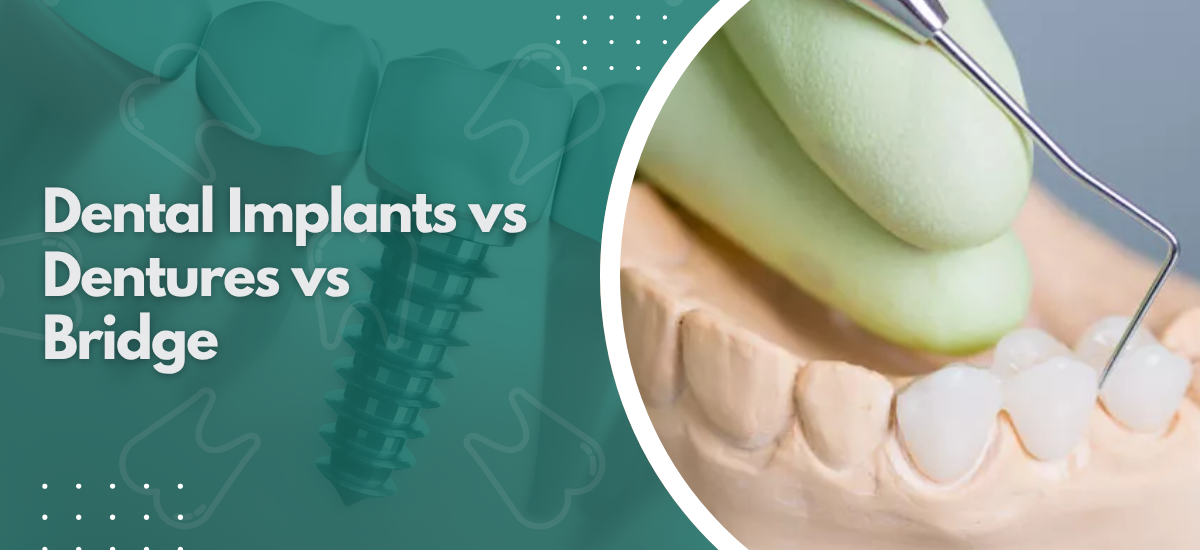
Dental implants, dentures, and bridges are three clinically different approaches to replacing missing teeth. Implants are considered the gold standard because they preserve jawbone and function like natural teeth. Bridges are a fixed alternative that works without surgery. Dentures are the most affordable option for replacing multiple missing teeth but are removable and allow bone loss to continue. The right choice depends on bone condition, number of missing teeth, medical history, and budget.
According to Dr. Suhrab Singh, renowned dentist in Noida, “the best tooth replacement option isn’t the most technically advanced one, it’s the one that fits the patient’s bone condition, oral health, and long term expectations rather than just the gap in their mouth.”
What Are the Key Clinical Differences Between These Three Options?
Each option works through a fundamentally different mechanism and that changes what it can and can’t do for the patient over time.
Implants: A titanium fixture placed into the jawbone acts as an artificial root which means bone stimulation continues, the jaw doesn’t shrink, and no adjacent teeth are damaged in the process, making dental implants the only replacement option that addresses bone loss rather than just filling the visible gap with the trade-off being the highest upfront cost and a treatment timeline of several months including healing.
Bridges: A bridge anchors onto the teeth on either side of the gap which get filed down to support the false tooth, so two healthy teeth take structural damage to replace one missing one and the underlying bone continues to shrink without a root to stimulate it, but bridges are faster, less expensive than implants, and fixed in place which makes them preferable to dentures for patients who aren’t surgical candidates.
Dentures: Full or partial dentures rest on the gum surface, cost the least upfront, and can replace many teeth at once, but they can slip, require adhesives and nightly cleaning, and allow bone loss to accelerate underneath them as the jaw changes shape over years of use without root stimulation.
Longevity: Implants can last a lifetime with adequate bone and hygiene, bridges typically need replacement after ten to fifteen years, and dentures need relining or replacement as jaw shape changes beneath them, which means the lowest upfront cost option often becomes the most expensive one over a thirty year horizon.
Full Arch Cases: All on 4 and similar implant supported solutions provide the stability and bone health benefits of implants with the cost efficiency of treating the full arch rather than replacing every tooth individually, making them significantly better than traditional removable dentures for patients who’ve lost most or all of their teeth.
For patients weighing these options the restoration sitting on top matters as much as the support structure beneath it and understanding what goes into dental crowns used across all three treatment types gives a clearer picture of where quality differences show up in daily function.
Which Option Is Right for Which Patient?
The clinical answer changes significantly depending on what’s actually happening in that specific patient’s mouth.
Single Tooth: Implants are preferred for single tooth replacement because they avoid damaging neighbouring teeth entirely, though bridges are faster and viable when the adjacent teeth already need crowns or significant restoration and the patient isn’t suitable for surgery.
Full Arch: Implant supported dentures like All on 4 provide better stability, better bone health, and better long term outcomes than traditional removable dentures, and for patients with adequate bone and no surgical contraindications they’re the stronger clinical recommendation for full arch cases.
Budget: Dentures offer the lowest initial cost and bridges sit in the middle, while implants represent a higher upfront investment that becomes a superior long term financial decision when the cost of repeated bridge replacement and bone loss management is factored across twenty to thirty years of use.
Medical History: Patients on blood thinners, with uncontrolled diabetes, or with significant bone loss need a detailed assessment before implants are confirmed as viable because healing and osseointegration depend on factors that vary considerably between patients and can’t be assessed without clinical examination and a 3D scan.
Age and Timing: Younger patients placed early get decades more bone preservation from implants than those who wait, while older patients need individual medical assessment, and in either case the sooner the replacement decision is made after tooth loss the better the bone volume available to work with.
Understanding what actually determines pricing across these options matters before making a short term decision, and the breakdown of dental implant cost in Noida explains why two quotes for the same procedure can look very different.
Why Choose Neo Dental Care?
Neo Dental Care offers digital implantology, fixed bridgework, and partial denture solutions alongside a full diagnostic workup using CBCT scanning and digital treatment planning, led by Dr. Suhrab Singh, NABH accredited dentist and recipient of the Best Dentist in Noida award at the National Quality Achievement Awards 2020.
Patients who’ve come here after being advised a single option elsewhere consistently say the treatment plan looked different after a proper clinical assessment. That’s not unusual. The right tooth replacement option for a specific patient’s jaw and health situation isn’t the same as the most commonly recommended one.