
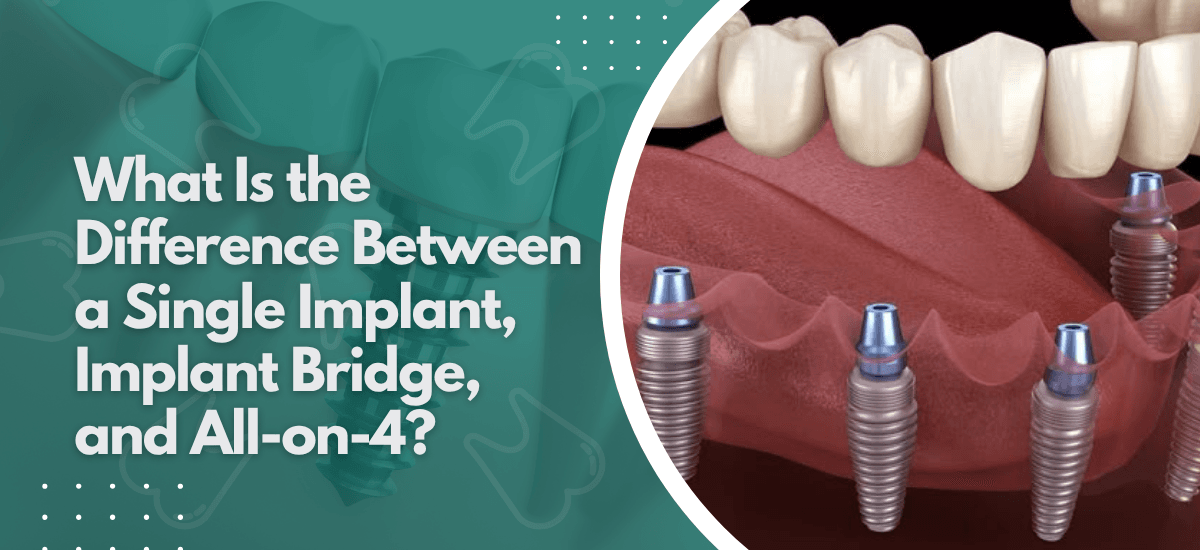
Dental implants are not a single treatment. They are a foundation technology that supports three distinct solutions depending on how many teeth are missing and what the jaw bone looks like. A single implant, an implant-supported bridge, and All-on-4 are each designed for different clinical situations, and choosing the wrong one for the wrong case produces a worse outcome at a higher cost. Understanding what separates them is the first step toward making the right decision.
According to Dr. Suhrab Singh, a dentist at Neo dental clinic in Noida,
“Patients often come in asking for All-on-4 because they have heard the name, or asking for a single implant because it sounds simpler. The question is never which option sounds best. It is which option matches what the jaw can support, how many teeth need replacing, and what the patient’s long-term oral health requires. Getting that match right is the entire consultation.”
Unsure which implant option is right for you?
What Makes Each Implant Option Different?
Each solution uses the same titanium post technology but applies it differently based on the number of missing teeth and available bone.
- Single implant: One titanium post placed into the jawbone supports one crown. It is the most conservative option, preserves the adjacent teeth entirely, and delivers the closest functional and aesthetic match to a natural tooth. It is the right choice for one missing tooth with adequate bone at that site.
- Implant-supported bridge: Two implants placed at either end of a gap support a fixed bridge spanning three or more teeth. It replaces multiple adjacent missing teeth without placing an implant at every site, making it more cost-efficient than individual implants for each gap while still being fixed and bone-preserving.
- All-on-4: Four implants, two placed axially at the front and two tilted posteriorly, support a full-arch fixed prosthesis of 10 to 14 teeth. It is designed for patients who have lost most or all teeth in one arch and want a permanent, non-removable solution without individual implants for every tooth position.
- How bone volume affects the choice: Single implants and bridges require adequate bone at each implant site. All-on-4 is specifically engineered to work with reduced bone volume by tilting the posterior implants to access denser bone at the front of the jaw, which is why it often avoids the grafting that other options would need.
Every assessment at Neo Dental Care begins with a CBCT scan that maps the exact bone volume available, and that is the right starting point for any dental implant in Noida decision before any treatment option is recommended.
How Do the Three Options Compare on Key Clinical Factors?
The differences between these options become clearest when placed side by side across the factors that matter most to patients.
- Number of teeth replaced: A single implant replaces exactly one tooth. An implant bridge replaces two to four adjacent teeth using two implants. All-on-4 replaces an entire arch of 10 to 14 teeth using four implants, making it the only option suited to near-total or total tooth loss.
- Surgical complexity and treatment time: A single implant is the most straightforward procedure, typically completed in one surgical visit with a healing phase of 3 to 6 months before the crown is fitted
- Bone grafting requirement: Single implants and bridges require sufficient bone at each implant site and may need grafting if that volume is absent.
- Long-term maintenance: Single implants and bridges are maintained like natural teeth with brushing, flossing, and regular professional cleaning.
Understanding how these options compare matters most when a patient is weighing cost, surgery, and long-term function together, and the clinical trade-offs become clearest when dental implants vs dentures vs bridge are placed side by side against each other across those same factors.
Factor | Single Implant | Implant Bridge | All-on-4 |
Teeth replaced | 1 | 2 to 4 adjacent | Full arch, 10 to 14 |
Implants placed | 1 | 2 | 4 per arch |
Bone grafting | Often needed if bone is low | Often needed if bone is low | Usually avoided |
Same-day teeth | No | No | Yes, temporary |
Best for | One missing tooth | Multiple adjacent gaps | Near-total or total tooth loss |
Why Choose Dr. Suhrab Singh at Neo Dental Care?
Dr. Suhrab Singh is an MDS-qualified implantologist at Neo Dental Care, Noida, recognised with the National Quality Achievement Award for Best Dentist in Noida 2020. The clinic operates within the NABH-accredited Neo Hospital and offers all three implant solutions: single implants, implant bridges, and full-arch rehabilitation under one coordinated treatment plan using CBCT imaging and internationally certified implant systems.
Frequently Asked Questions
They solve different problems. A single implant replaces one missing tooth. All-on-4 replaces an entire arch. The right choice depends on how many teeth are missing and what bone volume is available.
Yes. An implant-supported bridge uses two implants to support three or more crowns, replacing multiple adjacent teeth without placing an implant at every missing site.
The implants themselves are designed to last a lifetime. Clinical data shows survival rates of 95.7% at 13 years for the upper arch and 91.7% at 18 years for the lower arch.
Usually not. The posterior implants are angled to use available bone at the front of the jaw, which avoids grafting in most cases. Your dentist assesses this with CBCT imaging before deciding.