
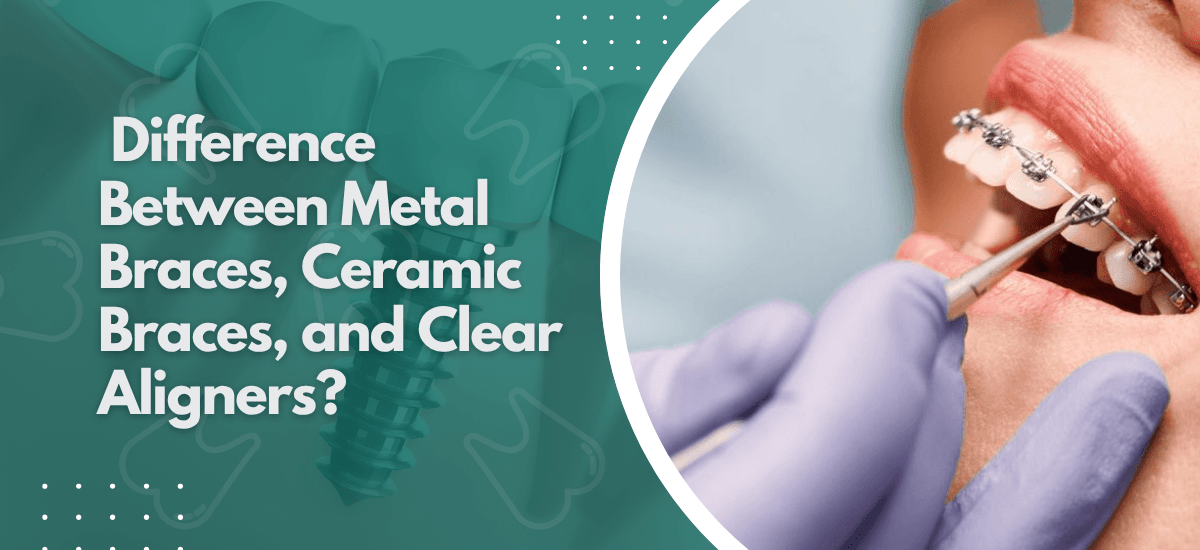
Metal braces, ceramic braces, and clear aligners are all capable of straightening teeth and correcting bite problems, but they do so with different materials, different mechanics, and different trade-offs between visibility, cost, and clinical capability. Patients often choose between them based on appearance alone, but the clinical suitability of each option for the specific misalignment present matters more than aesthetics in determining which produces the best long-term result
According to Dr. Suhrab Singh, a dentist at Neo dental clinic in Noida,
“Every patient who walks in asking for aligners because they do not want metal brackets is making a reasonable aesthetic preference, not a clinical decision. Some of those patients are perfect aligner candidates. “
Ready to find out which orthodontic option is right for your case?
What Makes Each Orthodontic Option Clinically Different?
The three appliances share the goal of moving teeth but differ fundamentally in how they generate and deliver force, what movements they handle best, and what they ask of the patient during treatment.
- Metal braces: Stainless steel brackets bonded to the front of each tooth are connected by an archwire that exerts continuous, precisely controlled force across the entire arch.
- Ceramic braces: Ceramic brackets work on identical mechanical principles to metal braces and use the same wire system. The clinical outcomes are equivalent when case selection is appropriate.
- Clear aligners: A series of custom-fabricated removable trays, each worn for one to two weeks, moves teeth incrementally through small, programmed steps planned digitally before treatment begins.
- How case complexity determines the choice: Mild to moderate crowding, spacing, and straightforward bite corrections can be addressed effectively by all three options.
All three options are available at Neo Dental Care as part of a clinically planned aligners and braces treatment programme, with each system selected based on the patient’s clinical needs.
How Do the Three Options Compare Across the Factors That Matter Most to Patients?
Beyond clinical capability, patients consistently ask about the same practical concerns when choosing between the three options. Each factor produces a different result depending on which appliance is used.
- Visibility and aesthetics: Metal braces are the most visible option and a fixed feature of the smile throughout treatment. Ceramic braces reduce visibility significantly and are largely unnoticed at normal conversational distance, though close inspection or photography makes the brackets apparent.
- Oral hygiene during treatment: Metal and ceramic braces create areas around brackets and under wires where plaque accumulates and is difficult to remove. Decalcification around brackets is a documented complication of fixed appliance treatment when oral hygiene is poor.
- Compliance and patient discipline: Metal and ceramic braces require no patient compliance once bonded, they work continuously. Clear aligners are only effective when worn 20 to 22 hours per day.
- Treatment duration and cost: Metal braces are the most affordable fixed option and handle complex cases in a comparable or shorter timeframe than aligners for the same degree of correction.
The distinction between how aligners and braces perform for adults specifically including which cases are genuinely better suited to each is covered in detail in our blog on clear aligners vs braces for adults.
|
Factor |
Metal Braces |
Ceramic Braces |
Clear Aligners |
|
Visibility |
High |
Low to moderate |
Minimal |
|
Clinical capability |
Full range |
Full range |
Mild to moderate cases |
|
Patient compliance required |
None |
None |
High, 20 to 22 hrs/day |
|
Oral hygiene difficulty |
Higher |
Higher |
Lower, removable |
|
Cost |
Lowest |
Moderate |
Highest |
|
Best for |
All case types, complex cases |
Aesthetic-conscious patients, moderate cases |
Mild to moderate, adult patients |
Why Choose Dr. Suhrab Singh at Neo Dental Care?
Dr. Suhrab Singh is an MDS-qualified dentist at Neo Dental Care, Noida, recognised with the National Quality Achievement Award for Best Dentist in Noida 2020. The clinic offers metal braces, ceramic braces, and clear aligner treatment within the NABH-accredited Neo Hospital, using digital treatment planning and case complexity assessment to determine which appliance suits each patient’s specific misalignment before any appliance is fitted.
Frequently Asked Questions
Both produce the same clinical outcomes as they use the same wire mechanics. Ceramic braces are less visible but cost more and require more careful maintenance to prevent staining. Metal braces are more durable and better suited to complex cases requiring high force levels.
For mild to moderate malocclusion, clinical studies show aligners and braces produce comparable outcomes. Braces are more effective for complex tooth movements, torque control, and cases requiring significant vertical correction. Aligners have an advantage in treatment duration for suitable cases.
Aligners can address moderate crowding effectively. Severe crowding, significant bite corrections, and cases requiring precise torque control are better managed with fixed braces. A clinical assessment determines which option is appropriate for the specific degree of misalignment
The ceramic brackets themselves are stain-resistant, but the elastic ties used to hold the wire can discolour with tea, coffee, turmeric, and certain foods. Modern ceramic systems with self-ligating brackets or coated ties reduce this risk significantly.