
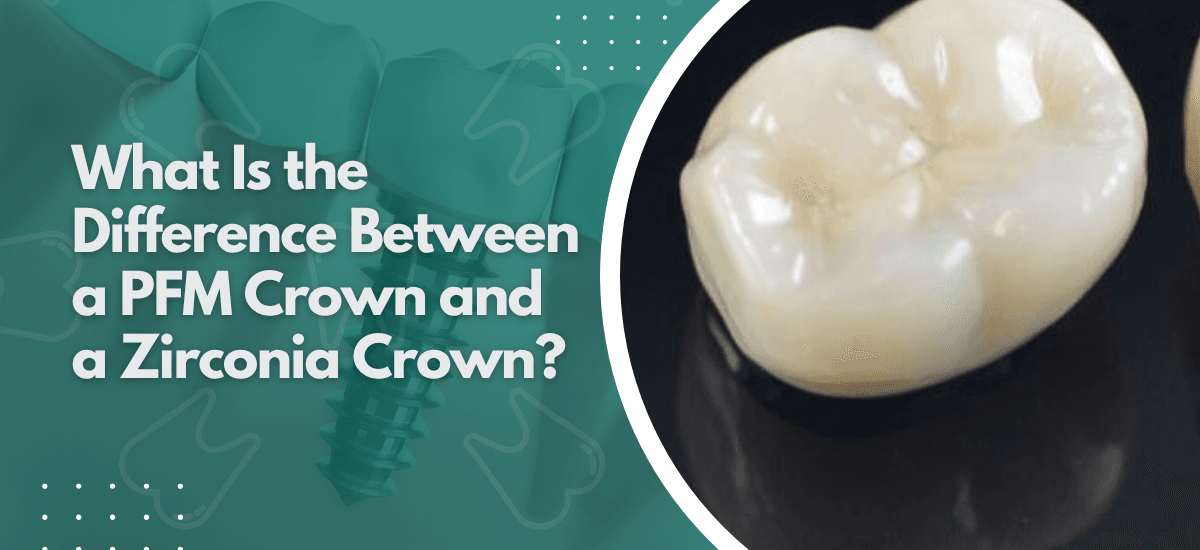
Dental crowns restore damaged, heavily filled, or root canal treated teeth, and the material chosen for that crown determines how it looks, how it performs, and how long it lasts. PFM porcelain-fused-to-metal has been the dominant crown material in dentistry for over five decades and has an extensive clinical evidence base.
According to Dr. Suhrab Singh,a dentist at Neo dental clinic in Noida,
“PFM and zirconia are both good materials when they are used for the right cases. PFM has decades of data and still performs well for long-span bridges. For single crowns, front teeth, and anything on an implant, zirconia is almost always the better choice now. Monolithic zirconia has neither of those problems because it is a single uniform material all the way through.”
Need a crown and unsure which material suits your case?
What Are the Structural and Clinical Differences Between PFM and Zirconia?
The two crown types differ at the most fundamental level, their construction and that structural difference determines every other clinical property.
- Material composition: A PFM crown has two distinct layers. The inner substructure is a cast metal coping, typically nickel-chromium alloy or in premium cases high-noble alloys, which provides the structural strength.
- Strength and fracture risk: Monolithic zirconia has a flexural strength of 900 to 1200 MPa, compared to the 60 to 100 MPa of the feldspathic porcelain used to veneer PFM copings.
- Aesthetics and gum compatibility: PFM crowns require an opaque layer to block the dark metal coping before the porcelain shade can be built up, which limits how closely they can mimic the depth and translucency of natural enamel.
- Tooth preparation requirements: PFM crowns require more aggressive tooth reduction to accommodate the combined thickness of the metal coping and the overlying porcelain, typically 1.5 to 2.0 mm on the outer surfaces.
The full range of crown materials, crown indications, and what the crown fitting procedure involves from tooth preparation to cementation is covered on our dental crown treatment in Noida page.
When Is a PFM Crown Still the Right Choice and When Should Zirconia Be Preferred?
Both materials have specific clinical situations where they represent the better option. The choice is not always a straightforward preference for the newer material.
- When zirconia is clearly preferred: Single crowns on anterior teeth, where aesthetic demands are highest and metal margin visibility is unacceptable. Implant-supported crowns, where zirconia’s superior surface properties reduce biofilm adhesion and where clinical data shows better long-term survival than PFM on implant platforms.
- When PFM remains clinically appropriate: Long-span bridges of four or more units, where the connector dimensions required for structural stability are difficult to achieve in zirconia without risking framework fracture at the connector sites. Cases where the budget for treatment is significantly constrained and a well-fitted PFM crown from a reputable laboratory remains a clinically sound, evidence-backed restoration.
- Layered zirconia as a middle option: For anterior teeth where the aesthetic demand is very high but a full-contour monolithic crown appears too opaque, layered zirconia a zirconia coping veneered with porcelain combines the metal-free substructure with the translucency of hand-layered ceramic.
- How the dentist’s assessment matters: The choice of crown material must account for the individual tooth, its position, the bite load it carries, the amount of remaining natural tooth structure, and whether it sits on a natural root or an implant.
A direct clinical comparison of how zirconia and PFM perform over time including fracture rates, chipping incidence, and survival data is covered in detail in our blog on zirconia vs PFM crown which lasts longer.
|
Factor |
PFM Crown |
Zirconia Crown |
|
Construction |
Metal coping plus layered porcelain |
Single monolithic block, CAD/CAM milled |
|
Flexural strength |
60 to 100 MPa (porcelain layer) |
900 to 1200 MPa |
|
Metal at gum margin |
Yes, visible as gum recedes |
No, fully metal-free |
|
Chipping risk |
15 to 25% within 5 years |
Minimal in monolithic design |
|
Aesthetics |
Good, limited translucency |
Excellent, natural light transmission |
|
Implant suitability |
Lower, metal scratches implant surface |
Higher, biocompatible and surface-safe |
|
Best for |
Long-span bridges, limited clearance |
Single crowns, front teeth, implants |
Why Choose Dr. Suhrab Singh at Neo Dental Care?
Dr. Suhrab Singh is an MDS-qualified restorative and prosthetic dentist at Neo Dental Care, Noida, recognised with the National Quality Achievement Award for Best Dentist in Noida 2020, supported by Dr. Anurag Parashar, MDS Prosthodontist and ex-PGIMER Chandigarh. The clinic operates within the NABH-accredited Neo Hospital and fabricates crowns through certified dental laboratories using internationally sourced zirconia and ceramic materials.
Frequently Asked Questions
Neither is universally better. Zirconia offers superior strength, no metal margin visibility, and better gum compatibility, making it preferred for front teeth and implant restorations. PFM has decades of proven clinical data and remains a reliable choice for back teeth and long-span bridges where connector dimensions are important.
Both have 5-year survival rates of 95 to 98% when correctly placed. Monolithic zirconia has a structural advantage in that it has no separate porcelain layer to chip. PFM crowns risk porcelain fracture over the metal substructure, which is their most common long-term complication.
The dark line at the gum margin of a PFM crown is the metal coping showing through as the gum recedes over time. It is a cosmetic limitation of all PFM restorations in visible positions. Zirconia crowns have no metal substructure and do not produce this appearance.
Yes. Monolithic zirconia is particularly well suited to posterior teeth because of its high flexural strength, which handles heavy bite forces without fracture. It is now the preferred material for most single posterior crowns and implant-supported molar restorations.