
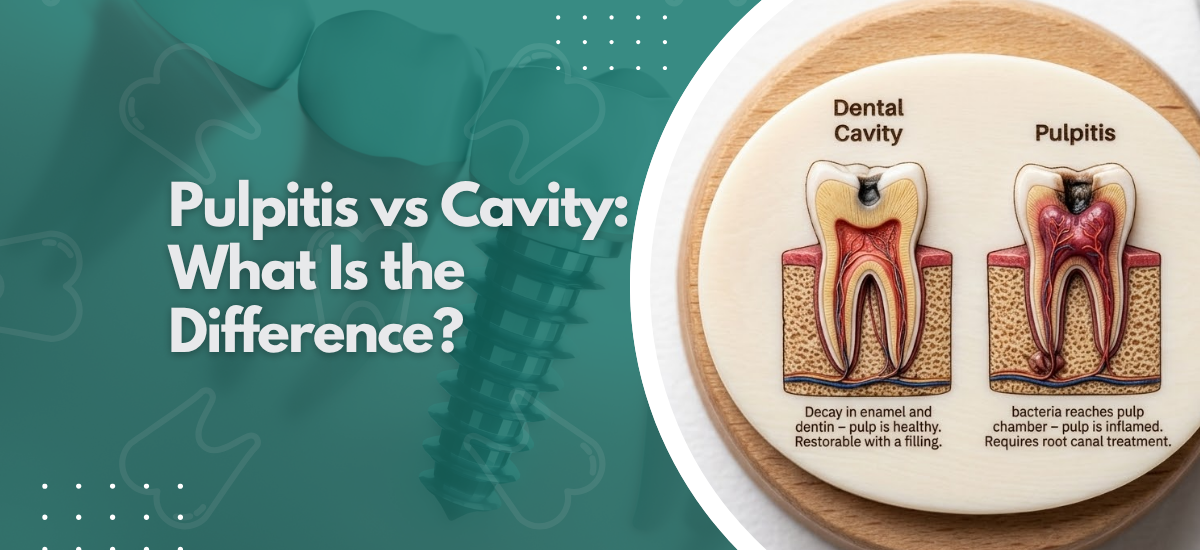
A cavity is a hole in the tooth caused by decay. Pulpitis is inflammation of the dental pulp, the living nerve and blood vessels inside the tooth. The two are connected: a cavity causes pulpitis. Leave decay untreated long enough and bacteria reach the nerve, and at that point a filling is no longer enough. A small cavity caught early needs a filling. Pulpitis, depending on how far it has gone, needs either a protective treatment to let the nerve settle or a root canal to remove tissue that cannot recover.
According to Dr. Suhrab Singh, a dentist at Neo Dental Care, the best dental clinic in Noida, “Patients come in assuming they have a cavity. Sometimes they do. But pain that lingers after a cold drink, wakes them at night, or throbs without a trigger that is pulpitis, not cavity pain. The management is fundamentally different. A filling will not fix pulpitis. Placing one over an already inflamed pulp without diagnosing the nerve first is one of the most common reasons a tooth ends up needing a root canal weeks after a routine procedure.”
Tooth pain that is not going away? Book an assessment with Dentist
How Are Pulpitis and a Cavity Different?
The two conditions involve different tissues, produce different symptoms, and require different treatment. A side-by-side comparison makes the distinction clear.
Factor | Cavity | Pulpitis |
Tissue affected | Enamel and dentin only | Dental pulp nerve and blood vessels |
Cause | Bacterial acid dissolving tooth structure | Bacterial invasion of the pulp, usually from untreated decay |
Pain character | Brief sensitivity to sweet, cold, or hot | Lingering pain, spontaneous throbbing, worse at night or lying flat |
Pain trigger | Present only with stimulus | May occur with no trigger at all |
Reversibility | Always reversible with early filling | Reversible if caught early; irreversible once pulp is significantly damaged |
Treatment | Filling, with no nerve involvement | Protective dressing for reversible; root canal for irreversible |
Urgency | Can wait days to weeks if not progressing | Irreversible pulpitis requires prompt treatment; risk of abscess increases daily |
Diagnosis | Clinical examination and X-ray | Pulp sensitivity tests, percussion test, X-ray, clinical history |
A cavity that is diagnosed and filled before it reaches the pulp will never become pulpitis. The problem is that early cavities are painless, which is why many patients do not present until the decay has already penetrated deep enough to compromise the nerve, and every root canal treatment in Noida case at Neo Dental Care,every root canal treatment in Noida begins a full pulp assessment to confirm the diagnosis.
What Are the Types of Pulpitis and What Does Each Require?
Not all pulpitis are the same. The clinical distinction between reversible and irreversible pulpitis determines whether the tooth can be saved conservatively or needs root canal treatment.
- Reversible pulpitis: The nerve is irritated but still alive. Cold or sweet triggers a sharp response that fades in seconds. Remove the decay, place a protective dressing, and the pulp can settle but only if it is addressed before the inflammation deepens.
- Irreversible pulpitis: Past the point of recovery. Pain comes on without warning, sticks around long after the trigger is gone, and tends to get worse when the patient lies down. The only way to keep the tooth is a root canal. There is no medication or filling that reverses it.
- Pulp necrosis: The nerve has died. Pain often drops off at this stage and patients assume things have improved on their own. They have not bacteria continue spreading into the bone beneath the root, quietly progressing toward an abscess.
- Asymptomatic irreversible pulpitis: No pain, but the damage is there. Usually picked up on an X-ray taken for something else entirely. Left alone it follows the same path as symptomatic irreversible pulpitis just without warning signs along the way.
Understanding whether an inflamed pulp can still recover is covered in our blog on inflamed pulp tooth.
Why Choose Dr. Suhrab Singh at Neo Dental Care?
Dr. Suhrab Singh is an MDS-qualified endodontist at Neo Dental Care, Noida, who has performed over 15,000 root canal procedures using dental operating microscopes and pulp vitality testing as standard diagnostic tools. The clinic operates within the NABH-accredited Neo Hospital and uses electric pulp testing, cold testing, and periapical digital radiography to accurately stage every case of pulpitis before treatment begins. Patients are never recommended for root canal without a confirmed diagnosis, and reversible cases are managed conservatively wherever the clinical evidence supports it.
Frequently Asked Questions
Nerve inflammation inside the tooth, usually caused by bacteria reaching the pulp through deep decay or a crack. Pain ranges from lingering temperature sensitivity to spontaneous throbbing.
Early reversible pulpitis can settle with a filling. Once irreversible, the nerve cannot repair itself and the root canal becomes unavoidable. Most patients presenting with real pain are already past the reversible stage.
Cavity pain is brief and stops with the trigger. Pulpitis pain lingers, appears without reason, or wakes you at night. An X-ray and pulp test confirm which it is.
The nerve dies, pain drops off, and patients think it has resolved but infection keeps spreading into the bone. An abscess forms and bone loss follows. Earlier treatment is always simpler.
Desclaimer:
This blog is for informational purposes only and does not constitute professional dental advice. Please consult a qualified dental professional for a diagnosis and personalised treatment plan.