
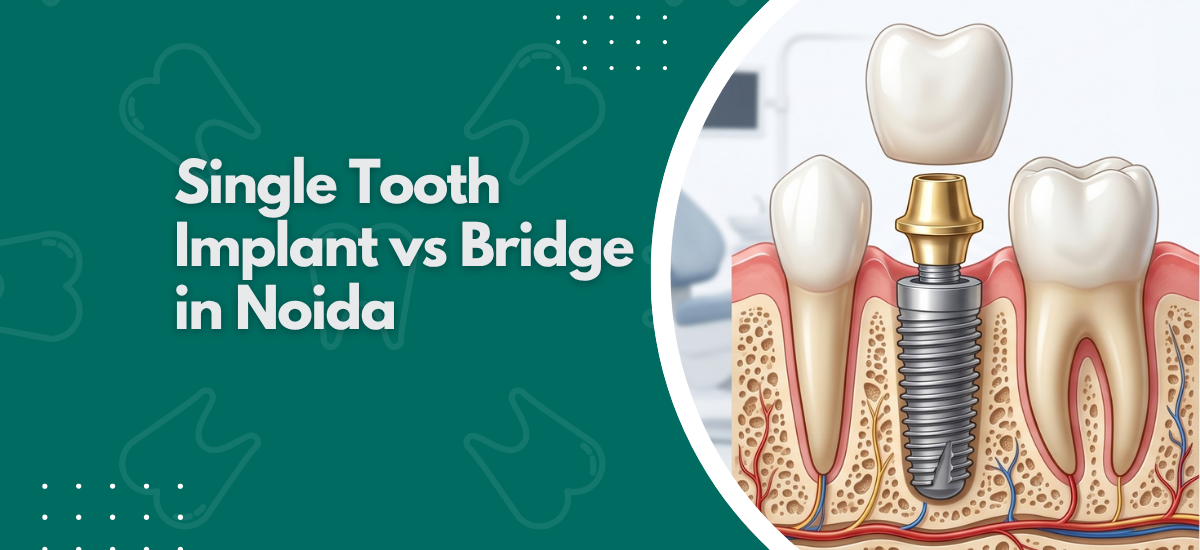
Both a single implant and a dental bridge replace one missing tooth. That is where the similarity ends. An implant places a titanium root into the jawbone, preserves the bone underneath, and leaves the neighbouring teeth completely untouched. A bridge anchors onto the teeth on either side of the gap which get filed down to carry the bridge and leaves the underlying bone to shrink without any root stimulating it. For most patients in Noida with adequate bone and no surgical contraindications, an implant is the stronger long-term choice. A bridge is faster, costs less upfront, and still makes clinical sense in specific situations.
According to Dr. Suhrab Singh, a dentist at Neo Dental Care, one of the best dental clinic in Noida, “Most patients come in having already made up their mind bridge or implant before anyone has looked at the teeth. If the neighbouring teeth already need crowns, a bridge makes complete sense. But if they are intact and healthy, filing them down irreversibly is the wrong call. The clinical situation decides it, not a preference.”
Missing a single tooth and unsure which option suits your case? Book an assessment with a dentist.
How Do a Single Implant and a Bridge Compare?
One replaces the root. The other replaces the visible tooth by borrowing support from the teeth on either side. That single difference drives every other clinical outcome between them.
Factor | Single Tooth Implant | Dental Bridge |
How it works | Titanium root placed into jawbone, crown on top | False tooth held by crowns cemented onto adjacent teeth |
Adjacent teeth | Not touched at all | Filed down irreversibly on both sides |
Bone preservation | Yes implant root stimulates bone | No bone shrinks under the pontic over time |
Treatment timeline | 3 to 6 months including osseointegration | 2 to 3 weeks |
Surgery required | Yes | No |
Longevity | Designed to last decades | 10 to 15 years before replacement |
10-year survival rate | 92 to 95% | Comparable, but includes adjacent tooth risk |
Cost in Noida | From Rs. 30,000 to 40,000 per implant | Lower upfront for the bridge unit |
Long-term cost | Better value over 20 to 30 years | Higher when replacement cycles and bone management are included |
Best for | Healthy adjacent teeth, adequate bone, long-term planning | Adjacent teeth already needing crowns, patient not suitable for surgery |
Both options are available at Neo Dental Care using CBCT-guided digital implant planning and internationally certified implant systems.The full breakdown of what the procedure involves from assessment to final crown is on our dental implant in Noida page.
When Does Each Option Make More Clinical Sense?
The table sets out the broad differences. These are the specific situations where one option consistently outperforms the other.
- Implant is the stronger choice when: The adjacent teeth on either side of the gap are healthy and unrestored. Filing them down to carry a bridge permanently reduces two structurally sound teeth to act as supports for one missing one and once that enamel is removed it is gone. An implant in this scenario preserves everything and is the clearly more conservative approach long term.
- Bridge remains clinically appropriate when: The neighbouring teeth are already heavily restored, already crowned, or in such poor condition that they are likely to need crowns regardless of what happens to the gap. In that situation, a bridge uses the existing clinical need rather than creating new damage. Patients who cannot undergo surgery due to medical conditions, anticoagulant therapy, or insufficient bone volume that is not suitable for grafting are also strong bridge candidates.
- Bone loss changes the equation over time: A bridge leaves the bone under the pontic without any stimulation. Within a year of tooth loss, measurable bone resorption begins at that site. Over five to ten years, the ridge changes shape enough that the bridge no longer fits flush to the gum, a gap opens at the pontic, and food traps consistently. An implant placed early prevents this entirely and maintains the bone architecture underneath it for the life of the restoration.
- Cost over time is not what it appears upfront: A bridge looks cheaper at the initial treatment stage. But a bridge typically needs replacement every 10 to 15 years, and each replacement involves the adjacent teeth again. When bone grafting eventually becomes necessary due to ridge resorption, and when the cumulative cost of repeated prosthetic work is added up across 30 years, the implant frequently costs less overall.
How implants compare across the full range of replacement options including what happens to the jaw and surrounding teeth when a gap is left untreated is covered in detail in our blog on dental implants vs dentures vs bridge.
Why Choose Dr. Suhrab Singh at Neo Dental Care?
Dr. Suhrab Singh is an MDS-qualified implantologist at Neo Dental Care, Noida, National Quality Achievement Award recipient for Best Dentist in Noida 2020, based inside the NABH-accredited Neo Hospital. Every implant case starts with a CBCT scan and a full bone assessment before any recommendation is made. Patients who arrive having been told they need a bridge elsewhere get that advice reviewed on clinical evidence not taken at face value.
For appointments, call +91 9818872732.
Frequently Asked Questions
For most patients with adequate bone and no surgical contraindications, a single implant is the stronger long-term choice. It preserves the adjacent teeth, prevents bone loss, and has a 10-year survival rate of 92 to 95%. A bridge is faster and viable when adjacent teeth already need crowns or the patient cannot undergo surgery.
A single implant is designed to last decades often a lifetime with proper maintenance. A 3-unit bridge typically lasts 10 to 15 years before needing replacement. The bone loss that continues under a bridge also changes the jaw over time.
Yes. A traditional bridge requires filing down the healthy teeth on either side of the gap to support the bridge crowns. This enamel removal is irreversible. An implant leaves the adjacent teeth completely untouched.
A single implant with crown at Neo Dental Care starts from Rs. 30,000 to 40,000. A 3-unit bridge involves three crowns and is typically lower upfront, but the long-term cost including replacement cycles and bone management often makes the implant the more economical option over 20 years.
Reference:
- https://pmc.ncbi.nlm.nih.gov/articles/PMC11379416/
- https://pmc.ncbi.nlm.nih.gov/articles/PMC12788601/
Desclaimer:
This blog is for informational purposes only and does not constitute professional dental advice. Please consult a qualified dental professional for a diagnosis and personalised treatment plan.