
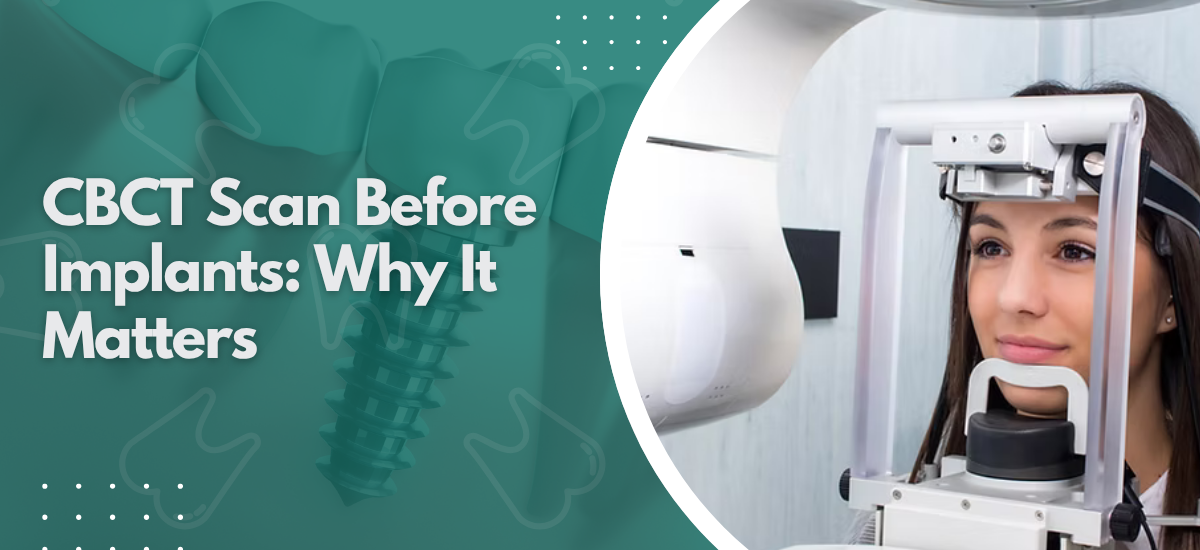
A CBCT scan stands for Cone Beam Computed Tomography and it’s a specialised imaging tool that produces a three dimensional map of the jaw covering bone density, bone height, nerve location, and sinus position in a single scan session. A standard dental X-ray produces a flat two dimensional image while a CBCT shows the jaw in all three planes simultaneously, giving the clinician the spatial information needed to plan implant placement accurately before surgery begins rather than making critical decisions based on estimated anatomy.
According to Dr. Suhrab Singh, renowned dentist in Noida, “placing an implant without a CBCT is like planning a building without a structural survey, you might get away with it but you’re working from assumptions rather than measurements and the consequences of getting it wrong are significant.”
What Does a CBCT Scan Actually Show That a Standard X-Ray Can’t?
The gap between what a conventional X-ray provides and what a CBCT provides isn’t about image quality but about which clinical decisions can actually be made from the data each one produces.
Bone Volume in Three Dimensions: A standard X-ray shows height but not width or depth so a clinician planning from a flat image is estimating the third dimension rather than measuring it, while dental radiology using CBCT gives all three measurements simultaneously so implant diameter, length, and angulation are confirmed before the surgical appointment rather than adjusted during it.
Exact Nerve Position: The inferior alveolar nerve runs through the lower jaw and placing an implant too close causes permanent numbness or paraesthesia in the lip and chin, and a CBCT shows precisely where the nerve sits relative to the proposed implant site in a way that a conventional periapical X-ray simply can’t provide regardless of how carefully it’s taken.
Sinus Floor Proximity: In the upper jaw the distance between the ridge crest and the sinus floor determines whether a standard implant can be placed or whether a sinus lift is needed first, and that measurement on a flat X-ray is a projection rather than a true spatial measurement that surgical decisions can be reliably based on.
Bone Density Assessment: Dense cortical bone and softer cancellous bone integrate with implants differently and affect healing timelines, torque values during placement, and whether additional stabilisation is needed, all of which can be assessed from the CBCT before surgery in ways that conventional imaging alone simply doesn’t support.
Adjacent Root Position: Teeth on either side of an implant site have roots that occupy space the implant must avoid, and the exact angulation and proximity of those roots is visible in three dimensions on a CBCT in a way that a flat image distorts or obscures depending on the angle it was taken at.
The data a CBCT provides changes what treatment planning for dental implants looks like at every stage from initial assessment through to surgical guide fabrication and final placement.
When Is a CBCT Scan Specifically Needed Before Implant Treatment?
Most implant cases benefit from a CBCT and the clinical argument for skipping it is harder to make than most patients realise when they’re told one isn’t necessary.
Single Implant in a Straightforward Site: Even cases that look simple on a standard X-ray can reveal unexpected anatomy on a CBCT including narrower bone width than projected, closer nerve proximity than estimated, or bone quality that changes the surgical approach entirely, which is why CBCT has become the standard of care for implant planning rather than an optional extra reserved for complex cases.
Multiple Implants Across an Arch: Placing four or six implants requires each fixture to relate correctly to the others spatially and a CBCT makes that planning possible by mapping the entire arch simultaneously rather than assessing each site from individual flat images that don’t show how each position relates to the next.
Cases Where Sinus Lift May Be Needed: The decision about whether a sinus lift is required or whether standard implant length is achievable within available bone is a measurement that has to be accurate, and a CBCT provides that in three dimensions compared to a conventional X-ray which projects the sinus floor onto a flat plane.
Patients With Significant Bone Loss: When bone has resorbed significantly after tooth loss or gum disease the remaining volume may be adequate in some directions and insufficient in others, and a CBCT identifies exactly where bone exists across all three planes before the surgical plan is finalised rather than after the first implant is already in.
Retreatment After Implant Failure: When a previous implant has failed the CBCT identifies the bone loss pattern, the angulation of the failed fixture if still present, and whether adjacent structures have been affected in ways that change what retreatment is possible and what preparatory steps are needed before anything new is attempted.
Patients planning upper jaw implants where sinus proximity is a concern will find that the CBCT findings directly determine whether a sinus lift is needed and which technique is appropriate based on the exact bone height measured at that specific site rather than estimated from a flat image.
Why Choose Neo Dental Care?
Neo Dental Care uses CBCT scanning as a standard part of its implant assessment protocol with digital treatment planning and surgical guide fabrication based on the three dimensional data, led by Dr. Suhrab Singh, NABH accredited dentist and recipient of the Best Dentist in Noida award at the National Quality Achievement Awards 2020.
Patients who’ve had implant consultations elsewhere based on conventional X-rays regularly find the treatment plan looks different after a proper CBCT assessment, and that difference is almost always in their favour in terms of both surgical accuracy and realistic expectations about what preparatory steps are actually needed.
