
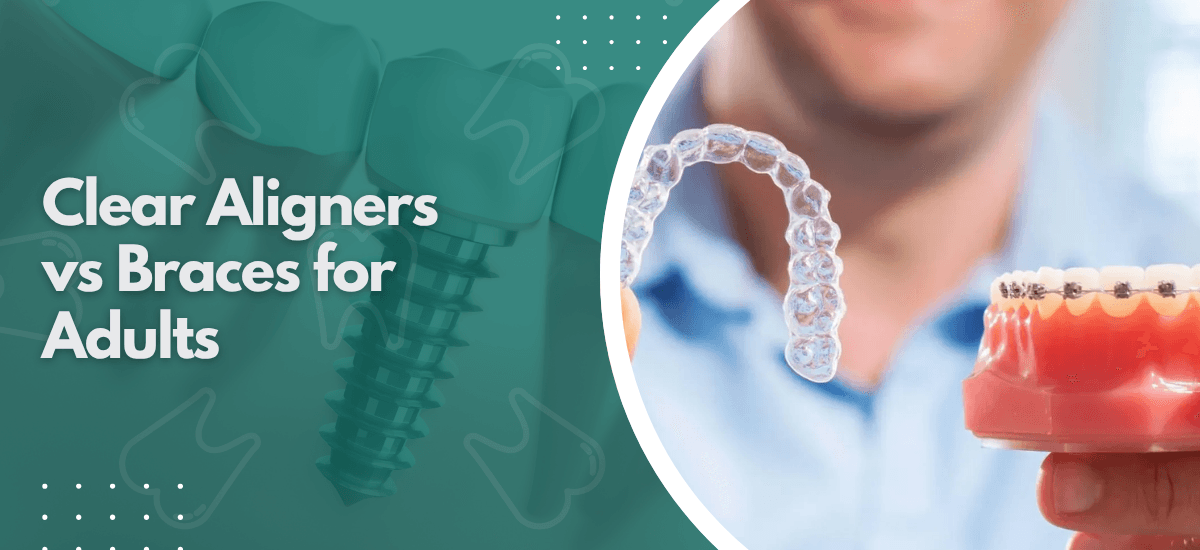
Clear aligners and braces are both effective for adults but neither is universally better because the right choice depends on how complex the misalignment is, how well the patient can commit to wearing a removable appliance, and what the treatment actually needs to achieve clinically. Aligners are removable and nearly invisible and work well for mild to moderate cases. Braces are fixed, more visible, and handle complex movements that aligners can’t reliably produce. A clinical assessment tells you which one fits your case and a preference based decision often doesn’t.
According to Dr. Suhrab Singh, renowned dentist in Noida, “most adults come in already decided on aligners because of how they look but the clinical picture doesn’t always support that choice and starting with the wrong appliance means a longer and more complicated treatment than necessary.”
Which Option Is Right for Which Adult Patient?
What the teeth actually need to do during treatment matters more than what the patient would prefer to wear and that’s the frame for every decision here.
Mild to Moderate Crowding: Aligners handle spacing issues, minor crowding, and small rotations well where the overall bite is functional and the movements needed are within the range the material can produce reliably, and a proper aligners and braces treatment assessment upfront is what confirms whether the case actually falls within that range before any trays are ordered.
Severe Crowding or Bite Issues: Cases with large overbites, underbites, crossbites, or significant multi-directional movement consistently do better with fixed braces because the mechanical control over each individual tooth is more precise and doesn’t depend on the patient wearing the appliance for a specific number of hours each day.
High Compliance Patients: Adults who can genuinely commit to twenty-two hours of daily wear and will consistently swap trays on schedule get good aligner results while patients who know from experience they struggle to maintain habits may actually do better with a fixed appliance that removes the compliance variable from the equation entirely.
Previous Orthodontic Treatment: Adults returning after relapse often have specific teeth that moved in predictable patterns and knowing which ones need the most correction helps determine whether attachments can manage the required movement or whether braces are the more reliable choice for getting back to the original result.
Budget and Duration: Aligner treatment is similarly priced to braces but the total cost can increase with refinements if tooth movements don’t track as planned, meaning longer complex cases with multiple refinement rounds can end up costing more than fixed braces would have for the equivalent outcome.
For patients considering cosmetic improvements alongside orthodontic treatment, how cosmetic dentistry procedures interact with the timing of orthodontic work affects sequencing decisions that can complicate the final result if the order isn’t planned correctly from the start.
What Are the Key Clinical Differences Between Aligners and Braces?
The difference goes well beyond how they look and understanding what each appliance can and can’t do clinically is what actually drives the decision.
Parameter | Clear Aligners | Fixed Braces |
Indication | Mild to moderate cases | Moderate to severe and complex cases |
Tooth Movement Control | Limited for complex movements | Precise control across all movements |
Compliance Requirement | High, requires 20 to 22 hours per day | Minimal, works continuously |
Visibility | Nearly invisible | Visible |
Oral Hygiene | Easier to maintain | Technique sensitive and time intensive |
For patients who’ve already completed orthodontic treatment and want to understand how consistent maintenance across all dental work connects to long term outcomes, the approach to dental implant care covers how the same commitment to ongoing maintenance that applies to orthodontic retention also determines how well other restorations hold up over time.
Why Choose Neo Dental Care?
Neo Dental Care offers both clear aligner and fixed brace treatment for adults with full digital treatment planning and clinical case assessment to determine which option fits the situation rather than defaulting to what the patient walked in requesting, led by Dr. Suhrab Singh, NABH accredited dentist and recipient of the Best Dentist in Noida award at the National Quality Achievement Awards 2020.
Adults who came in certain about aligners have left with braces after assessment and consistently reported better outcomes than their previous orthodontic experiences where the appliance was chosen based on preference rather than what the case actually required.
