
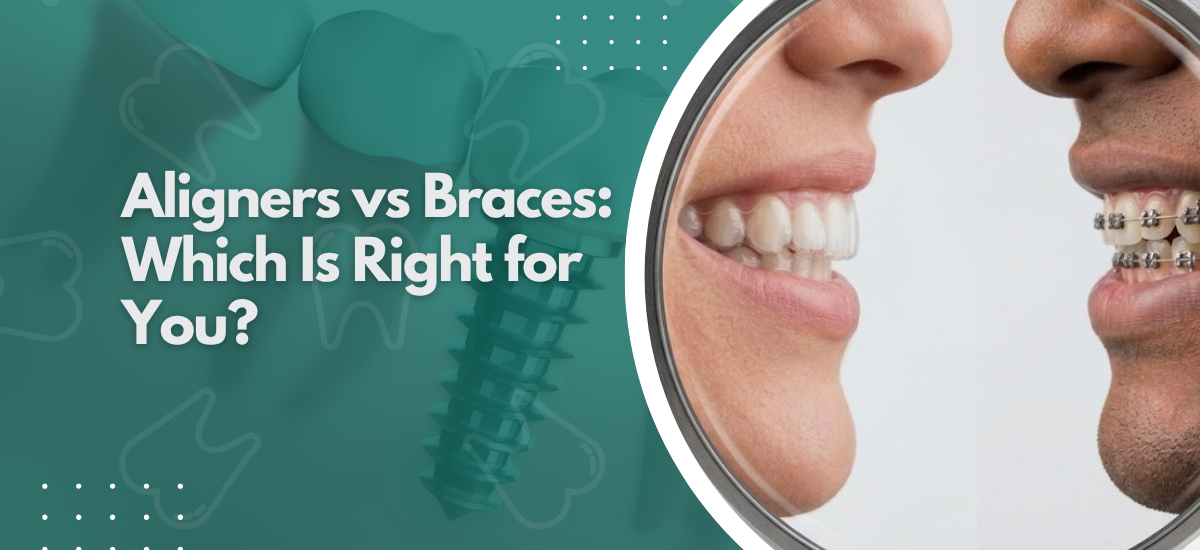
Choose aligners if you want invisible, removable, and comfortable trays for mild to moderate tooth straightening. Choose braces if you need strong mechanical correction for severe crowding, complex bite issues, or rotated teeth. Braces work continuously, no compliance required. Aligners demand 20 to 22 hours of daily wear and only move teeth when they are in the mouth. Both options work. The right one depends entirely on what your teeth actually need to do during treatment, not on which option you prefer the look of.
According to Dr. Suhrab Singh, the best dentist in Noida, “Most patients walk in having already decided on aligners. That preference is understandable; nobody wants to spend 18 months with metal brackets. But if the case involves severe crowding, a significant bite correction, or teeth that need precise rotation, aligners will not deliver the same result that braces would. The appliance has to match the clinical problem. Not the other way around.”
Not sure which option suits your case? Book an assessment with a dentist
How Do Aligners and Braces Compare?
Two very different mechanisms one fixed and continuous, one removable and compliance-dependent.
Factor | Clear Aligners | Metal Braces |
Visibility | Nearly invisible | Visible brackets and wires |
Removability | Removable for eating and cleaning | Fixed throughout treatment |
Compliance required | 20 to 22 hours daily | None — works continuously |
Best for | Mild to moderate crowding and spacing | Complex bite corrections, severe crowding, all case types |
Oral hygiene | Easier — removed for brushing | Harder — plaque accumulates around brackets |
Treatment duration | Avg. 1.7 months shorter for mild cases | Reliable for complex cases regardless of duration |
Cost in Noida | Rs 80,000 to Rs 1,50,000+ | Rs 25,000 to Rs 40,000 |
Torque and rotation control | Limited | High precision |
Patient satisfaction | Higher for comfort and aesthetics | Higher for predictable outcomes in complex cases |
The best dental clinic in Noida for orthodontic treatment offers both options under a single coordinated assessment not a default recommendation and the full range of braces and aligner treatments available at Neo Dental Care is covered on our aligners and braces treatment in Noida page.
Which Cases Are Better Suited to Aligners and Which to Braces?
The clinical situation narrows the choice faster than any preference.
- Aligners suit patients who: Have mild to moderate crowding, spacing, or simple bite discrepancies within the mechanical capability of plastic tray material. Work in professional or client-facing roles where visible brackets would be a constant concern. Can genuinely commit to 20 to 22 hours of daily wear patients who know from experience they struggle with habits may actually get better outcomes with a fixed appliance that removes compliance from the equation entirely.
- Braces suit patients who: Have severe crowding, significant overbites, underbites, crossbites, or cases requiring precise three-dimensional force across the full arch simultaneously. Have previously attempted aligners without completing treatment, or returned after relapse with teeth that moved in patterns better corrected by continuous wire mechanics. Want the lower upfront cost and do not want to manage a removable appliance throughout treatment.
- What the clinical data shows: A 2024 study comparing 50 aligner patients and 50 brace patients found comparable outcomes for mild to moderate cases aligners achieved 75% PAR score reduction vs 80% for braces at 12 months, with aligners finishing 1.7 months faster on average. A 2025 patient-reported outcomes study of 150 patients confirmed significantly higher comfort and satisfaction scores for aligner patients. For severe cases, braces consistently outperform aligners on treatment precision regardless of compliance.
- When the choice sits in the middle: A moderate crowding case in a patient who travels frequently and cannot guarantee consistent aligner wear sits at a genuine crossroads. The clinical assessment identifies not just the misalignment but the patient’s real-world ability to manage whichever appliance is chosen which is why the recommendation at Neo Dental Care is always built on both the clinical picture and an honest discussion about lifestyle.
How long different orthodontic cases take from mild spacing corrected in under a year to complex bite cases taking 24 months or more and what drives that timeline is covered in our blog on how long braces take to straighten teeth.
Why Choose Dr. Suhrab Singh at Neo Dental Care?
Dr. Suhrab Singh is an MDS-qualified orthodontist at Neo Dental Care, Noida NABH-accredited, inside Neo Hospital, Sector 50 National Quality Achievement Award recipient for Best Dentist in Noida 2020. The clinic offers metal braces, ceramic braces, and clear aligner treatment with digital bite analysis and case complexity assessment before any appliance is fitted. Patients who arrive certain about aligners leave with the appliance that fits their clinical situation.
Frequently Asked Questions
For mild to moderate cases, clinical studies show comparable outcomes. A 2024 study of 100 adults found aligners achieved a 75% PAR score reduction versus 80% for braces at 12 months, and aligners finished faster. For severe crowding, complex bite corrections, and large rotations, braces consistently produce more reliable results.
20 to 22 hours daily. Aligners only move teeth when they are in the mouth. Patients who remove them more than prescribed extend their treatment and risk poor tooth movement accuracy.
Metal braces in Noida cost Rs 25,000 to Rs 40,000. Clear aligners range from Rs 80,000 to Rs 1,50,000 or more. Braces cost less upfront and handle all case types including severe corrections that aligners cannot manage.
Not reliably. Significant bite corrections, large rotations, and severe crowding need the continuous three-dimensional force control that only fixed braces deliver. Aligners work best for mild to moderate alignment issues where compliance is consistent.
Reference:
- https://pmc.ncbi.nlm.nih.gov/articles/PMC11805330/
- https://pmc.ncbi.nlm.nih.gov/articles/PMC12156765/
Desclaimer:
This blog is for informational purposes only and does not constitute professional dental advice. Please consult a qualified dental professional for a diagnosis and personalised treatment plan.