
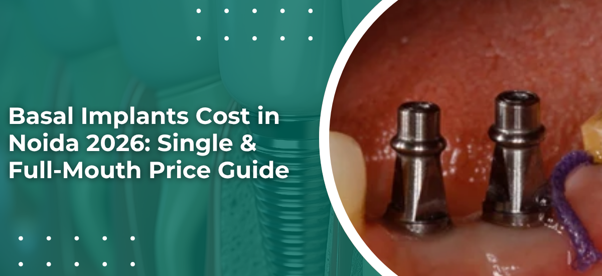
Basal implants cost ₹15,000 to ₹50,000 per single implant in Noida. A full-mouth case usually runs ₹2.5 lakh to ₹5 lakh per jaw. The price depends on the implant brand, the number of implants, and your bone condition. Below, you will find the full 2026 price breakdown, when basal implants make sense, and how they compare with conventional implants at our dental clinic in Noida.
“As a team, our philosophy is simple. Conventional implants are our first choice, because they are the most predictable option and are backed by decades of published research. We suggest basal implants only when conventional implants are not possible — such as severe bone loss — or when a patient cannot wait three to four months for healing and still wants fixed teeth.”
— The Neo Dental Care Implant Team
Missing a single tooth and unsure which option suits your case? Book an assessment with a dentist.
What Are Basal Implants?

Basal implants are a type of dental implant. They anchor into the dense basal (cortical) bone of the jaw. This basal bone rarely shrinks, so it can hold an implant even when the upper bone is thin. Doctors also call them corticobasal or immediate-load implants. The field behind them is known as basal implantology. As a result, basal dental implants are mainly used for patients with heavy bone loss who want fixed teeth quickly.
Basal Implants Cost in Noida (2026)
|
Treatment |
Cost in Noida (2026) |
|
Single basal implant (with crown) |
₹15,000 – ₹50,000 |
|
Typical per-implant range |
₹20,000 – ₹40,000 |
|
Implant-supported bridge (multiple teeth) |
₹80,000 – ₹1,50,000 |
|
Full-mouth rehabilitation (per jaw) |
₹2.5 lakh – ₹5 lakh |
|
Consultation + CBCT / 3D scan |
₹500 – ₹2,000 |
These are indicative ranges. Your exact quote needs a clinical exam and a CBCT scan
Want to know your exact implant cost? Get a CBCT-based quote with no obligation.
What Affects Basal Implant Cost?
Several factors decide your final price: the number of implants, the implant brand (premium systems like Simpladent or IHDE cost more), your bone condition, the prosthesis type, and diagnostics like a CBCT scan.
Basal Implants vs Conventional Implants

|
Factor |
Basal implants |
Conventional implants |
|
Predictability |
Lower; case-dependent |
High and well-documented |
|
Research & evidence |
Limited; not widely accepted |
Decades of published studies |
|
Regulatory status |
Many systems not FDA-approved |
Widely FDA-approved |
|
Bone grafting |
Usually not needed |
Often needed if bone is low |
|
Time to fixed teeth |
48 – 72 hours |
3 – 6 months |
|
Best for |
Severe bone loss; patients who cannot wait |
Most patients with adequate bone |
Want a fuller comparison of fixed-teeth options? Read our guide on the single implant vs bridge vs All-on-4.
What Our Team Recommends: Conventional First
We want to be straight with our patients. Conventional implants are our first choice in almost every case. They are more predictable, and decades of published research support them. They are also widely FDA-approved.
Basal implants have limited long-term research and limited mainstream acceptance. Many basal systems are not FDA-approved. Therefore, our team recommends them only in two situations:
- Severe bone loss where conventional implants are not possible without major grafting.
- Patients who cannot wait three to four months for healing but still want fixed teeth.
If a conventional implant can do the job well, we will recommend that route first.
Advantages of Basal Implants (in the Right Cases)
For the specific patients above, basal implants offer real benefits:
- Often no bone grafting. They use the basal bone, so many patients skip grafts and sinus lift surgery.
- Immediate loading. Fixed teeth can be placed within 48 to 72 hours.
- Faster, sometimes lower-cost path. Avoiding grafts can save time and surgical fees.
Disadvantages of Basal Implants
- Less predictable than conventional implants. Outcomes depend heavily on the case and the operator.
- Limited research and acceptance. Basal implants have far less published evidence than conventional implants.
- Not FDA-approved in many cases. Several basal systems lack the regulatory clearance conventional implants have.
- Needs a specific skill set. Fewer clinicians are trained in the technique, so experience matters.
- Not ideal for single small gaps. They are designed for full-mouth and bone-loss cases, not a one-tooth fix in healthy bone.
In short, the right candidate matters as much as the implant. A proper scan and an honest opinion protect your result.
Not sure which implant is right for you? Get an honest, scan-based assessment from our team.
Who Is a Good Candidate for Basal Implants?
Basal implants are not for everyone. Generally, our team considers them only if:
- You have severe jaw bone loss and conventional implants are not possible without major grafting.
- You cannot wait three to four months for healing but still want fixed teeth.
- You understand the trade-offs and prefer a faster, graft-free option.
A scan must confirm this first. A careful check protects both your health and your budget.
How Our Team Plans Implant Treatment at Neo Dental Care
Our implant team at Neo Dental Care plans every case together, and Dr. Suhrab Singh leads the clinic. We assess each patient honestly and recommend the option with the best long-term outcome. In most cases, that is a conventional implant.
Furthermore, we use digital dental implantology for precise, guided placement. We work inside a NABH-accredited, hospital-grade facility with 986+ reviews at 4.8 stars. Where basal implants are genuinely the better choice, our team plans them with the same care. Explore our full dental implants in Noida page for details.
Ready to find the right fixed-teeth option for you? Talk to our implant team today.
Frequently Asked Questions
Basal implants in Noida cost ₹15,000–₹50,000 per single implant in 2026. A typical implant falls in the ₹20,000–₹40,000 range. Full-mouth treatment costs about ₹2.5 lakh–₹5 lakh per jaw.
For most patients, conventional implants are better. They are more predictable, backed by decades of research, and widely FDA-approved. Our team recommends basal implants only for severe bone loss or when a patient cannot wait three to four months for healing.
Basal implants are less predictable than conventional implants. They have limited published research and acceptance, and many systems are not FDA-approved. They also need a specific skill set and suit full-mouth or bone-loss cases more than a single gap.
Sometimes. Basal implants often skip bone grafting and sinus lifts, which can lower the total and speed up recovery. However, predictability and long-term outcome matter more than cost alone.
Very fast. Basal implants allow immediate loading. Therefore, fixed teeth can be placed within 48 to 72 hours of surgery in suitable cases.
Usually not. They anchor into the dense basal bone, so most patients avoid grafts. This is why they are mainly used for cases with significant jaw bone loss.
This article gives general information only. It is not a substitute for a clinical exam. Implant suitability and cost depend on your case, so please consult a qualified implant dentist before treatment.