
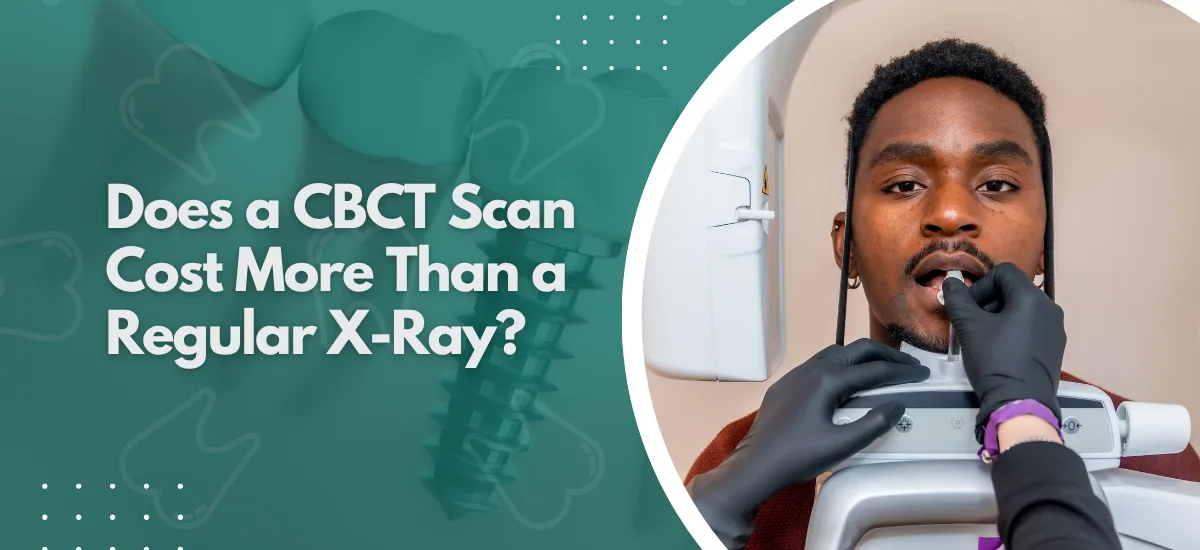
A CBCT scan does cost considerably more than a standard dental X-ray, and the difference comes down to the imaging technology involved, not clinic pricing. A conventional X-ray in India typically falls between 125 and 700 rupees. A CBCT scan sits in a different bracket entirely, generally between 1500 and 5000 rupees, depending on the area scanned and the city. Because a CBCT produces a full three dimensional dataset rather than a single flat image, it changes what a dentist can actually plan from it.
According to Dr. Suhrab Singh, one of the Best Dentist in Noida, “The cost difference is real, but it is not arbitrary. A CBCT generates a full three dimensional model of the jaw, nerve position, bone density, sinus proximity, all at once. A standard X-ray simply cannot provide that. For most day to day concerns, a regular X-ray remains entirely appropriate. It is only when a case genuinely requires that additional detail that the added cost becomes worth discussing.”
What Actually Drives the Price Difference Between a CBCT and a Regular X-Ray?
The cost gap is not about clinic markup. It comes down to what each machine is designed to capture, a distinction most patients only consider once a treatment plan calls for it.
Imaging technology involved: A regular X-ray uses a single exposure to produce a flat, two dimensional image. A CBCT machine works differently, rotating around the head and capturing multiple images that are reconstructed into a three dimensional model. That processing requires considerably more advanced equipment.
Radiation dose: There’s more radiation involved in a CBCT than in a standard intraoral or panoramic X-ray. Managing that dose safely means built in calibration and monitoring, and equipment capable of doing that reliably is not inexpensive.
What each one actually shows: Bone volume. Nerve position. Sinus proximity. A CBCT delivers all three in three dimensions, while a regular X-ray gives height only, nothing on depth or width.
When each is used clinically: Implant planning, sinus lift assessment, and complex root canal cases typically call for a CBCT. Routine checkups and simple cavity detection generally don’t.
Understanding this distinction determines what imaging a case actually needs. A visit to our dental radiology in Noida department clarifies which scan applies to your situation.
When Is the Additional Cost of a CBCT Actually Justified?
Not every dental concern requires three dimensional imaging. Some clearly do.
Dental implant planning: Before placing an implant, knowing the exact bone volume, nerve location, and sinus boundaries changes what can be planned with confidence, something a standard X-ray cannot offer.
Extractions near a nerve or sinus: A CBCT reduces the uncertainty a surgeon would otherwise be working with when a tooth sits close to either structure.
Retreating a failed root canal: Odd canal anatomy, or a treatment that did not hold the first time, often calls for the additional detail a CBCT provides, particularly when paired with microscopic evaluation.
Orthodontic and jaw planning: Some cases genuinely need three dimensional data to plan accurately. This is decided case by case, not applied as a routine step.
This is closely related to why a CBCT scan matters before implant treatment specifically, where the same reasoning applies in greater detail.
Why Choose Dr. Suhrab Singh for Dental Imaging in Noida?
Dr. Suhrab Singh has practiced restorative and implant dentistry in Noida for over twelve years, holds an MDS qualification, and received the National Quality Achievement Award for Best Dentist in Noida in 2020. His clinic was also the first in Noida to adopt digital dental implantology, supported by in house CBCT imaging.
So the imaging recommendation is always based on the specific case rather than a fixed protocol. Patients are not advised to undergo a CBCT when a standard X-ray would answer the clinical question just as well. Call +91 9755712732 to book your consultation.
Frequently Asked Questions
The image itself is the reason. A CBCT builds a complete three dimensional model, which takes far more advanced equipment to produce than a standard flat X-ray.
For most implant cases, yes, since bone volume and nerve position aren’t visible on a standard X-ray.
It does. That said, the dose stays within a safe diagnostic range and varies with the area being scanned.
Yes, for most routine concerns a standard X-ray is entirely sufficient.
Disclaimer
This article is for general information only. Consult a dentist to determine which imaging is appropriate for your specific case.