
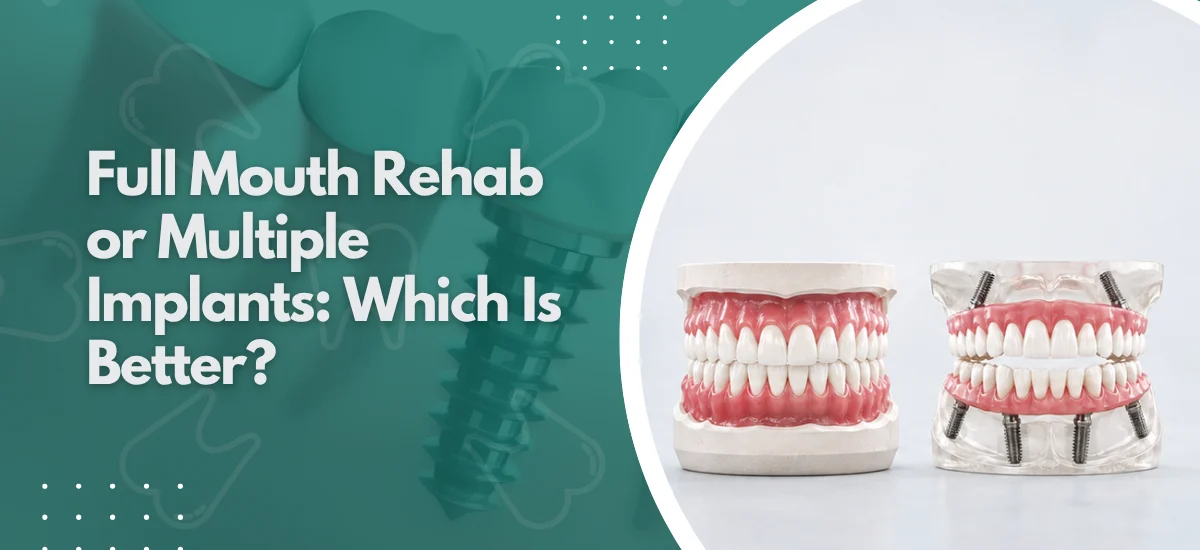
Neither approach is automatically the better choice, since they’re built to solve two different problems. Full mouth rehabilitation using a full-arch system like All-on-4 or All-on-6 replaces an entire row of missing or failing teeth using just four to eight implants supporting one fixed prosthesis. Multiple individual implants, on the other hand, replace specific missing teeth scattered across the mouth, with each implant working independently of the rest. So the real question isn’t which technology wins, it’s which problem you’re actually solving. What fits a given patient comes down to how much natural dentition remains, how much bone volume is available, and how many teeth genuinely need replacing.
According to Dr. Suhrab Singh, one of the Best Dentist in Noida, “Patients often assume more implants automatically means a better result. That’s not how this works. If someone still has healthy teeth scattered through their mouth, replacing each gap individually usually makes more sense than a full-arch system. But once an entire arch has failed or is missing, trying to save individual teeth one at a time often costs more in the long run and doesn’t function as well.”
When Does Full Mouth Rehabilitation Make More Sense Than Individual Implants?
A handful of specific situations point toward a full-arch approach. Not always the obvious ones.
Most or all teeth in an arch are missing or failing: Once an entire arch is compromised, a full-arch system supported by four to eight implants tends to be more predictable and stable than individually replacing or saving what remains.
Advanced bone loss across the arch: Full-arch protocols are specifically designed to work with reduced bone volume, often using angled implant placement to avoid areas where bone has receded.
A patient wants one coordinated outcome: Full mouth rehabilitation lets the bite, aesthetics, and function get planned together as a system, rather than treating each tooth as its own separate decision.
Fewer implants can support more teeth: A full-arch prosthesis typically needs only four to eight implants to support ten or more teeth. So the cost per tooth replaced often ends up lower than treating each gap individually.
A dental implant treatment evaluation in Noida, including a full bone and bite assessment, is where this decision actually gets made.
When Are Multiple Individual Implants the Better Choice Instead?
Full-arch treatment isn’t the default answer for every case involving several missing teeth.
Healthy teeth remain scattered through the mouth: When most of the natural dentition is intact and healthy, replacing individual gaps preserves more of what’s already working well.
Missing teeth aren’t concentrated in one arch: A patient missing a few teeth on the upper right and a couple on the lower left is usually better served by individual implants than a full-arch system built for total arch replacement.
Long-term data supports both approaches: Clinical studies tracking implant survival over ten years show comparable success rates across different implant configurations. The right number really does depend on the case, not a fixed rule.
Future flexibility matters to some patients: Individual implants can be treated, replaced, or maintained one at a time without affecting the rest of the mouth. Not every patient prioritizes this, but plenty do.
Deciding between these two paths overlaps closely with understanding full mouth rehabilitation and who actually needs it, which breaks down this decision further for patients with more advanced tooth loss.
Why Choose Dr. Suhrab Singh for Full Mouth or Multiple Implant Treatment in Noida?
Dr. Suhrab Singh has practiced implant dentistry and full mouth rehabilitation in Noida for over twelve years, holds an MDS qualification, and received the National Quality Achievement Award for Best Dentist in Noida in 2020.
The clinic has documented multiple full mouth rehabilitation cases involving ceramic crowns, extractions, and full-arch implant restoration. Every treatment plan is built around CBCT imaging and digital occlusal analysis before either approach gets recommended. Call +91 9818872732 to book your consultation.
Frequently Asked Questions
Not necessarily. Fewer implants supporting a full arch can sometimes cost less overall.
Sometimes, though it depends on how much bone and healthy tooth structure remain.
Full-arch cases often finish faster, since treatment gets coordinated in one plan.
Not really. Both are designed to function and feel like natural teeth once healed.
Disclaimer
This blog is for educational purposes only and is not a substitute for a professional dental evaluation. See a dentist for a full assessment before deciding between treatment options.