

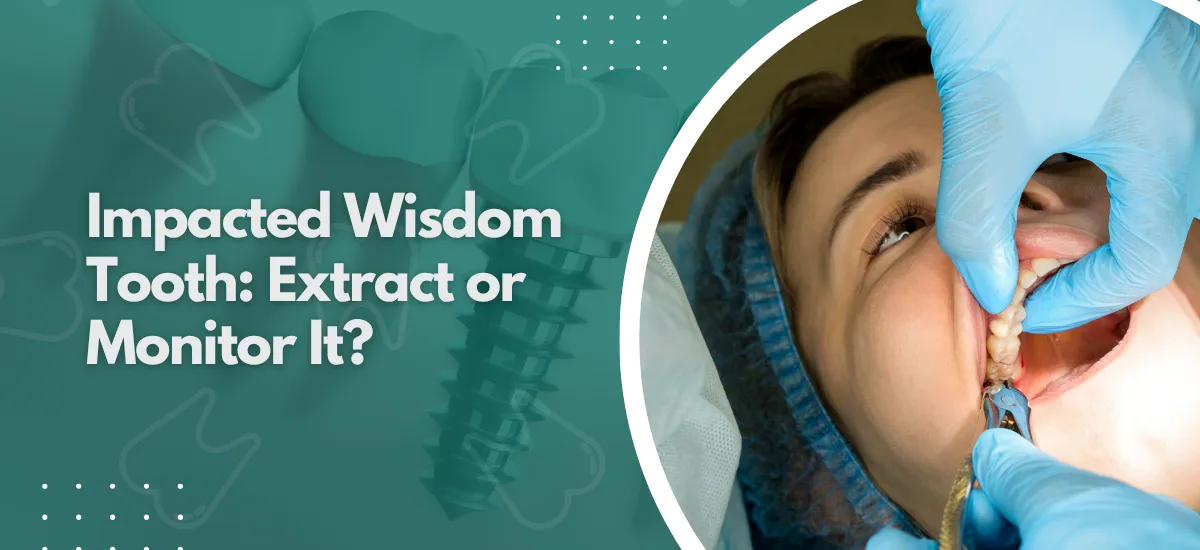
An impacted wisdom tooth doesn’t automatically need to come out. The decision rests on symptoms, position, and what’s happening to the tooth sitting right next to it. Extraction becomes the right call once pain, infection, decay on the neighboring molar, or a cyst enters the picture. Monitoring stays reasonable only when the tooth is silent, disease free, and something a toothbrush can actually reach. Not a guess. What actually settles it is the X-ray, not age or general advice.
According to Dr. Suhrab Singh, one of the Best Dentist in Noida, “Patients often expect a single rule for every case, but that isn’t how this works. If a wisdom tooth is impacted yet stays free of infection, decay and cyst formation, and doesn’t affect the tooth beside it, it can usually be monitored rather than removed. That changes immediately once there’s pain, infection, or any impact on the second molar. The decision comes down to what the imaging shows, not how the tooth feels on a given day.”
When Does an Impacted Wisdom Tooth Need to Be Extracted?
A few specific findings push a wisdom tooth from watch and wait into come out territory.
Pain or recurring infection: Pericoronitis causes swelling and soreness around a partly erupted tooth, and once it starts it tends to come back again and again. Extraction breaks that cycle instead of treating each flare up on its own.
Decay on the neighboring molar: An impacted tooth pressed against the second molar traps food and plaque somewhere no toothbrush can reach. So the second molar often decays first, before the wisdom tooth itself shows any real damage.
A cyst or lesion around the tooth: Sometimes an X-ray reveals a dentigerous cyst forming around an unerupted tooth. Left alone, it can expand and damage the bone or roots nearby. Rare, but worth ruling out.
Orthodontic or crowding concerns: A wisdom tooth pushing against the dental arch can shift alignment over time, which is why extraction sometimes gets recommended even without pain.
A simple and surgical tooth extraction in Noida evaluation, backed by proper imaging, confirms whether any of these actually apply. The X-ray tells the real story.
When Is Monitoring Actually the Safer Option?
Not every impacted tooth needs to come out right away. Some genuinely do better left alone, which surprises a lot of patients who assume impacted always means urgent.
Fully asymptomatic and deeply positioned: A tooth causing no pain or pressure, sitting well below the gum line, doesn’t need urgent removal.
Clean and reachable: If the area around the tooth stays plaque free, even while partially erupted, regular monitoring with periodic X-rays works just fine.
No cyst or bone changes on imaging: Stable imaging over time, with no cyst formation or bone loss, supports watching rather than operating.
Older age or added medical risk: Extraction risk climbs with age and certain health conditions. But in these cases, watching a stable tooth is often the safer path.
The same risk benefit thinking applies to an infected tooth. Read Root Canal or Extraction: Which Is Right to understand the choice.
Why Choose Dr. Suhrab Singh for Wisdom Tooth Care in Noida?
Dr. Suhrab Singh has performed thousands of tooth extractions and impaction evaluations across a career spanning more than a decade. He holds an MDS qualification and uses CBCT 3D imaging to map root position and nerve proximity before recommending extraction or monitoring.
Every impacted wisdom tooth gets checked against symptoms, imaging, and risk to the adjacent tooth before a decision is made. No shortcuts. That’s what keeps a tooth from being extracted just because it’s impacted, while also making sure a genuinely damaging case doesn’t sit unchecked until it harms the tooth next to it. Call +91 9755712732 to book your consultation.
Frequently Asked Questions
No. It’s only removed if it causes pain, decay, infection or a cyst.
Yes. Regular X-rays confirm there aren’t new symptoms or bone changes.
A clinical exam and imaging check symptoms, position and risk to nearby teeth.
Not usually. Most cases are simple outpatient procedures under local anesthesia.
Disclaimer
This article explains general factors used to decide between extracting or monitoring an impacted wisdom tooth and does not substitute a professional dental evaluation. Please consult a dentist for imaging and an assessment specific to your tooth.