
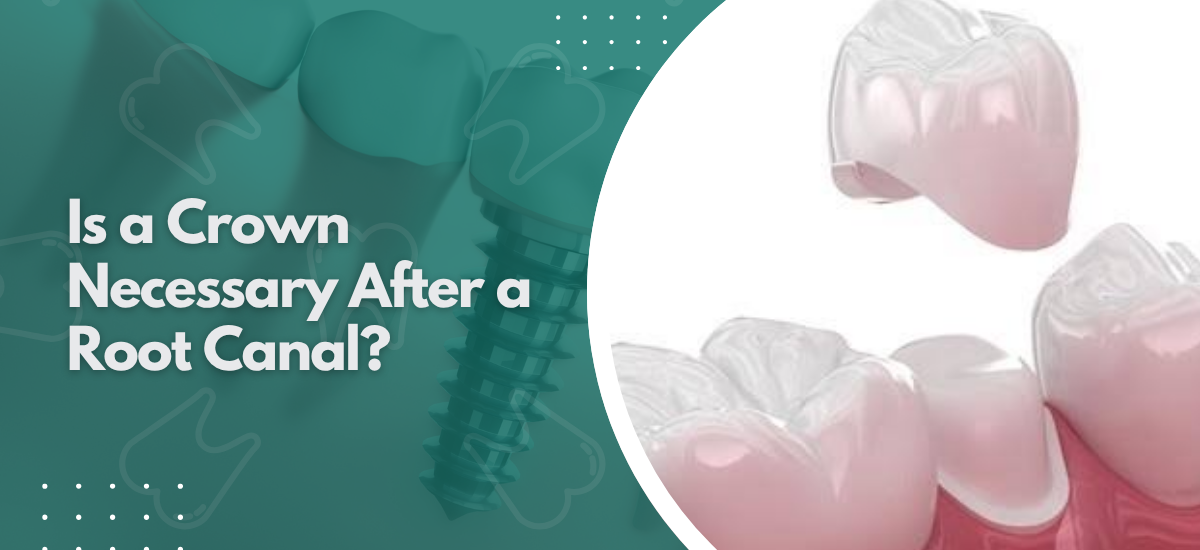
Almost always yes. Root canal treatment removes the nerve and blood supply from inside the tooth. What is left is structurally intact but biologically dead, no moisture exchange, no internal repair mechanism, no flexibility. The tooth becomes brittle over time and significantly more vulnerable to fracture under the forces of normal chewing. A crown wraps the entire tooth, distributes bite load evenly, and seals the access cavity against reinfection. Without one, the root canal saves the tooth from infection but leaves it exposed to the mechanical failure that most commonly ends a root canal treated tooth’s life.
According to Dr. Suhrab Singh, one of the best dentist in Noida, “A root canal without a crown is half a treatment. The infection is gone, but the tooth is not protected. I see patients who had a root canal elsewhere two or three years ago, never got the crown, and now the tooth has cracked vertically.A vertical root fracture is almost always non-restorable.That is a completely avoidable outcome. That is a completely avoidable outcome. The crown is not an optional add-on. It is what completes the treatment.”
Worried about a root canal treated tooth?Book an assessment with a dentist.
Why Does a Root Canal Treated Tooth Need a Crown?
The reasons are structural, biological, and supported by clinical data.
- Loss of tooth structure during treatment: The root canal procedure requires an access opening through the crown of the tooth to reach the canals. This removes a portion of tooth structure that cannot be replaced. The remaining walls of the tooth are thinner and more prone to flexing under bite force which over time leads to cracks that propagate from the crown down into the root.
- Brittleness from loss of internal moisture: A living tooth exchanges moisture and minerals continuously through the dentinal tubules. A root canal treated tooth no longer has this internal supply. The dentin dehydrates gradually, losing some of its natural flexural resilience. The tooth does not become instantly fragile, but over months and years it handles occlusal forces less forgivingly than a vital tooth.
- Fracture is the leading cause of root canal tooth loss: Clinical studies consistently identify coronal or root fracture as the most common reason root canal treated teeth are eventually extracted. Teeth without cuspal coverage have approximately six times higher failure rates than those restored with full crowns.The crown is not aesthetic, it is structural protection against the failure mode that actually
- The temporary filling is not a long-term solution: At the end of a root canal appointment, a temporary filling seals the access cavity. This is a short-term measure only temporary materials leak over weeks and allow bacterial reinfection of the cleaned canals. An 8-year retrospective study confirmed that delaying crown placement significantly reduces survival of root canal treated teeth. The crown needs to go in as soon as possible, not months later when the patient gets around to it.
The full range of crown options available after root canal treatment including material choice, cost, and what the fitting appointment involves is covered on our dental crown treatment in Noida page.
Are There Any Situations Where a Crown Is Not Needed After a Root Canal?
Yes but they are specific and clinically defined. The decision is not about preference or budget.
- Front teeth with minimal structural loss: Upper and lower incisors that have had root canals through a small lingual access cavity, with the majority of the tooth structure intact, can often be restored with a composite filling rather than a full crown. The bite forces on front teeth are lower than on molars, and the tooth walls remain relatively intact if the access was conservatively prepared. A clinical assessment of the remaining structure determines whether a crown is genuinely necessary or whether direct restoration is viable.
- When a crown is always necessary: Any molar or premolar that has had a root canal needs a crown no exceptions. These teeth carry the full force of chewing and grinding on a daily basis. The cusps are the most vulnerable points of a root canal treated back tooth. A filling leaves them unsupported. Crown placement covers and protects the cusps entirely, which is why the survival data for crowned versus uncrowned posterior root canal teeth is so dramatically different.
- Timing matters as much as the decision itself: A crown placed within a few weeks of root canal completion gives the tooth full protection before normal chewing forces accumulate. Patients who delay the crown sometimes for months, sometimes permanently are leaving the tooth in its most vulnerable state during the period when fracture risk is highest. If a crack develops before the crown is placed, the crown may no longer be an option.
- What happens if the crown is skipped entirely: The tooth is functional for a period. Then it cracks usually a cusp fracture initially, which may be repairable. If the crack extends into the root below the gum line, a vertical root fracture has occurred. There is no predictable way to repair a vertical root fracture. The tooth is extracted. The cost of an implant to replace that tooth exceeds the combined cost of the root canal and crown that would have prevented the situation.
How crown costs in Noida compare across materials zirconia versus PFM, what drives the price difference, and what the fitting appointment involves is covered in detail in our blog on dental crown cost in Noida in 2026.
Why Choose Dr. Suhrab Singh at Neo Dental Care?
Dr. Suhrab Singh is an MDS-qualified endodontist at Neo Dental Care, Noida NABH-accredited, inside Neo Hospital, Sector 50 he has received the National Quality Achievement Award 2020, with over 15,000 root canal procedures performed under dental operating microscopes. Every root canal treatment at Neo Dental Care includes a post-treatment restoration plan, crown material, timing, and cost confirmed before the patient leaves the appointment.
Frequently Asked Questions
For most posterior teeth molars and premolars yes. Clinical data shows endodontically treated molars without cuspal coverage have approximately six times higher failure rates than those restored with full crowns. Front teeth with minimal structural loss may be exceptions, but posterior teeth under heavy bite force almost always need a crown.
As soon as possible ideally within a few weeks of completing the root canal. An 8-year retrospective study confirmed that delaying crown placement significantly reduces survival of root canal treated teeth. The temporary filling placed at the end of the root canal is not a long-term solution.
For front teeth with sufficient remaining structure, a composite filling may be adequate. For back teeth under chewing load, a filling leaves the cusps unprotected and vulnerable to fracture. A cracked root after root canal is usually not repairable and the tooth is lost.
A zirconia crown at Neo Dental Care costs Rs 8,000 to Rs 18,000. A PFM crown costs Rs 5,000 to Rs 10,000. The crown cost is separate from the root canal treatment fee and is planned at the same appointment to allow time for fabrication.
Reference:
- https://pmc.ncbi.nlm.nih.gov/articles/PMC7041432/
- https://pmc.ncbi.nlm.nih.gov/articles/PMC12604680/
Desclaimer:
This blog is for informational purposes only and does not constitute professional dental advice. Please consult a qualified dental professional for a diagnosis and personalised treatment plan.