
Choose a dental bridge if you want a fixed, natural-feeling replacement for 1 to 3 adjacent missing teeth and have strong neighbouring teeth on either side of the gap that can serve as anchors.Choose a partial denture if you have multiple missing teeth spread across the arch, need a more budget-friendly option, or lack the healthy anchor teeth a bridge requires. Both are clinically proven solutions, the right one depends on how many teeth are missing, where they are, the condition of your remaining teeth, and your long-term oral health priorities.
According to Dr. Suhrab Singh, a dentist at Neo Dental Care, the best dental clinic in Noida, “Most patients arrive having already decided. A bridge because it sounds more permanent, a denture because it seems simpler. Both can be right. Both can be wrong. The decision has to start with a clinical picture, not a preference.”
Unsure which option suits your case? Book an assessment with a Dentist.
How Do a Partial Denture and a Dental Bridge Compare?
The two options differ in construction, how they sit in the mouth, what they require from the remaining teeth, and how they perform over time.
Factor | Dental Bridge | Partial Denture |
Type | Fixed, cemented permanently | Removable, taken out for cleaning |
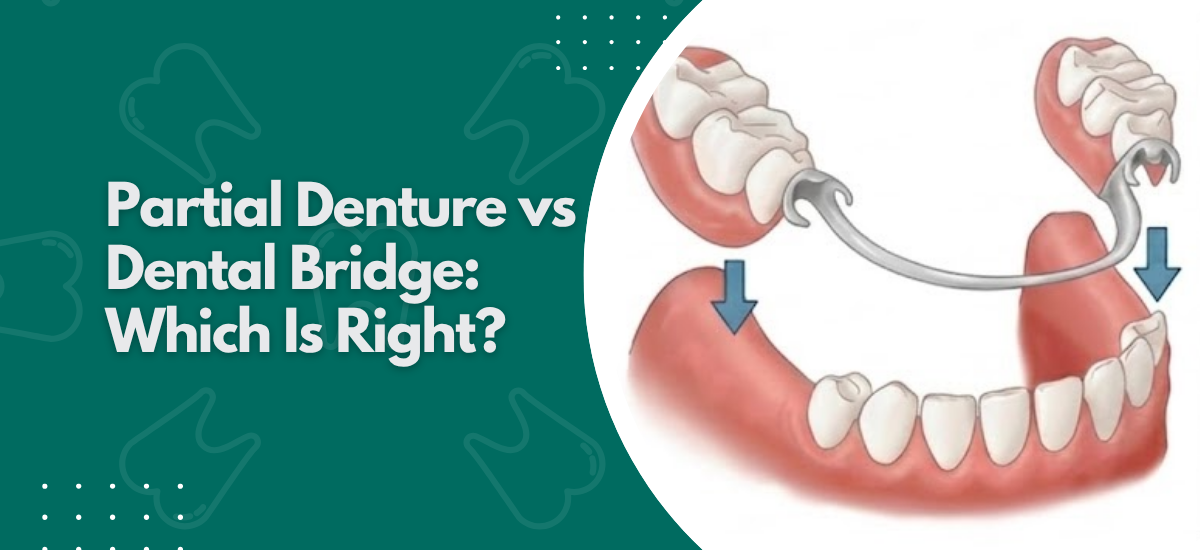
How it is held | Crowns on anchor teeth on either side of gap | Metal or flexible clasps on remaining natural teeth |
Number of missing teeth | Best for 1 to 3 adjacent teeth | Suitable for multiple teeth, including non-adjacent gaps |
Anchor teeth requirement | Healthy teeth on both sides of gap essential | No specific anchor requirement |
Tooth preparation | Adjacent teeth filed down for bridge crowns | None to adjacent teeth |
Bone preservation | No root stimulation, bone loss continues | No root stimulation, bone loss continues |
Stability | Fixed, no movement | Can shift or flex during chewing |
Oral hygiene | Flossing requires a threader under the bridge | Removed for cleaning, easier oral hygiene |
Longevity | 10 to 15 years | 5 to 8 years before relining or replacement |
Cost | Moderate to high | Lower upfront, higher cumulative over time |
Best suited for | 1 to 3 adjacent missing teeth, strong anchor teeth | Multiple or spread-out missing teeth, no suitable anchors |
Both options allow the jaw bone to continue losing volume over time because neither replaces the tooth root. Patients for whom bone preservation is a long-term priority are directed toward implant-based solutions at the clinical assessment, and the full comparison between all three options is covered on our dentures in Noida page alongside our implant and bridge services.
Which Clinical Factors Determine Whether a Bridge or Partial Denture Is the Right Choice?
The clinical assessment narrows the decision down to the individual patient’s situation, and several specific factors consistently determine which direction the recommendation goes.
- Condition of the anchor teeth: A bridge is only as stable as the teeth supporting it. If neighbouring teeth are virgin and unrestored, preparing them solely to anchor a bridge removes healthy enamel irreversibly a partial denture or implant is more conservative in those cases.
- Number and distribution of missing teeth: One to two adjacent missing teeth with sound neighbours is the ideal bridge case. Multiple gaps across separate quadrants cannot be bridged, making a partial denture the only non-implant solution that addresses the full picture in a single appliance.
- Patient’s ability to manage the appliance: A bridge is passive no daily removal, no soaking, no insertion technique. Partial dentures require daily removal and cleaning, and patients who are inconsistent with this develop problems at clasp sites and under the denture saddle over time.
- Budget and treatment timeline: A partial denture costs less upfront and is ready in two to three weeks. A bridge costs more per unit but the 5 to 8 year replacement cycle of a denture means cumulative cost over 20 years often exceeds a well-maintained bridge.
Understanding how these options compare on bone health, long-term function, and cost over a 20 to 30 year horizon is covered in our blog on dental implants vs dentures vs bridge
Why Choose Dr. Suhrab Singh at Neo Dental Care?
Dr. Suhrab Singh is an MDS-qualified restorative and prosthetic dentist at Neo Dental Care, Noida, recognised with the National Quality Achievement Award for Best Dentist in Noida 2020. The clinic operates within the NABH-accredited Neo Hospital and offers fixed bridgework, flexible and metal partial dentures, and implant-based alternatives as part of a complete tooth replacement assessment. Patients are never directed to a single option without a full clinical evaluation.Every recommendation is built around the specific teeth present, the bone condition, and the patient’s long-term oral health plan.
Frequently Asked Questions
A bridge is fixed and better for 1 to 3 adjacent missing teeth with healthy anchor teeth on either side. A partial denture suits multiple or spread-out gaps, or cases where suitable anchors are not available.
A bridge typically lasts 10 to 15 years. A partial denture needs relining or replacement every 5 to 8 years as the jaw changes shape beneath it.
Metal clasps can place lateral stress on anchor teeth over time. Regular review and adjustment manages this, and precision attachment designs distribute forces more evenly than conventional clasps.
Yes. Traditional bridges require irreversible enamel reduction on both neighbouring teeth. Implant-supported bridges avoid this entirely by anchoring to an implant instead.
Reference:
https://pmc.ncbi.nlm.nih.gov/articles/PMC12182389/
https://pmc.ncbi.nlm.nih.gov/articles/PMC8874059/
Desclaimer:
This blog is for informational purposes only and does not constitute professional dental advice. Please consult a qualified dental professional for a diagnosis and personalised treatment plan.