
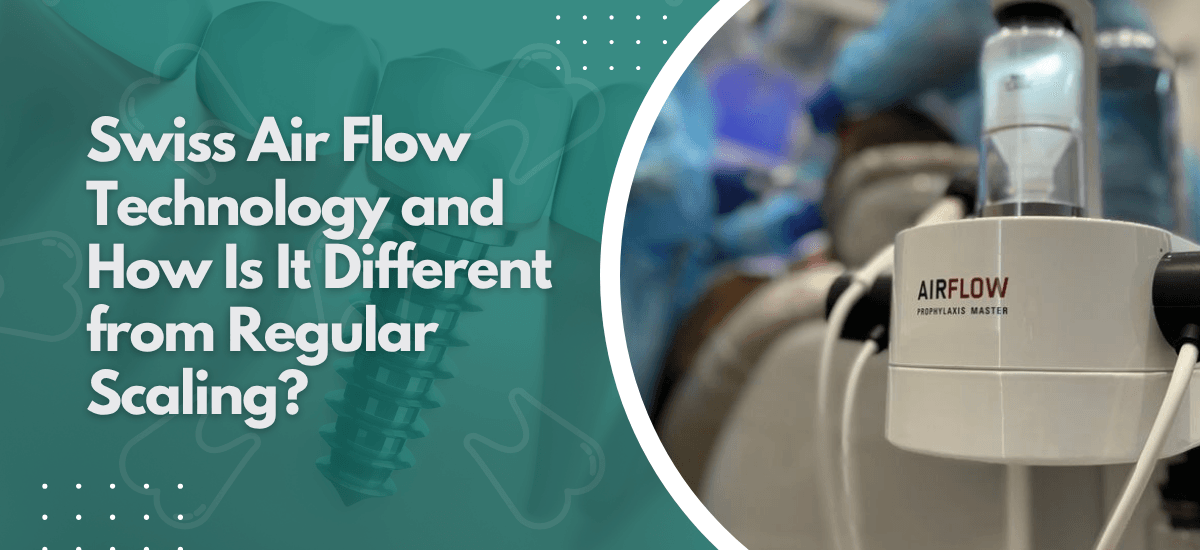
Most patients associate dental cleaning with metal instruments scraping against their teeth, sensitivity, and a degree of discomfort that makes them avoid or delay the appointment. Swiss Air Flow, the EMS AIRFLOW system used as part of the Guided Biofilm Therapy protocol, changes this experience entirely. Instead of mechanical scraping, it uses a precisely controlled stream of pressurised air, water, and ultrafine powder to remove biofilm, stains, and soft deposits from tooth surfaces, gum margins, and below the gumline without metal contact on the tooth surface in most cases.
According to Dr. Suhrab Singh, a dentist at Neo dental clinic in Noida,
“Conventional scaling works, but it works by scraping. The metal tip contacts the tooth, removes calculus and plaque mechanically, and in the process creates roughness on the surface that actually makes it easier for biofilm to reattach. The result is a cleaner tooth surface with less trauma to the enamel and gum tissue, and significantly less discomfort for the patient.”
Interested in experiencing Swiss Air Flow cleaning?
How Does Swiss Air Flow Technology Work and What Makes It Different?
The difference between Air Flow and conventional scaling is not just comfort. It is a fundamentally different approach to what dental cleaning targets and how it achieves that target.
- Biofilm-first approach: Conventional scaling targets calculus — the hardened mineralised deposits visible on the teeth. Biofilm, the soft bacterial film that causes gum disease and caries, is not the primary focus and is often incompletely removed around brackets, implants, and below the gumline. Air Flow targets biofilm first and specifically.
- Erythritol powder technology: The powder used in modern Air Flow systems is ultrafine erythritol, a naturally derived sugar alcohol with a particle size of 14 microns far finer than the sodium bicarbonate powders used in older air polishing systems.
- PERIOFLOW subgingival cleaning: One of the most clinically significant advantages of the Air Flow system is the PERIOFLOW nozzle, a flexible thin tip that delivers erythritol powder into periodontal pockets up to 9mm deep.
- Piezon No Pain for remaining calculus: After Air Flow removes all soft biofilm and stain, only mineralised calculus remains on the teeth. The Piezon ultrasonic scaler, which operates at a frequency specifically tuned to avoid sensitivity, addresses only these calcified deposits.
Neo Dental Care was the first clinic in Noida to offer this complete GBT protocol, and the full details of the technology and what patients can expect at each step are on our Swiss Air Flow technology for painless scaling page.
Where Does Swiss Air Flow Have the Biggest Clinical Advantage Over Conventional Scaling?
Air Flow and GBT outperform conventional scaling most significantly in specific clinical situations where conventional instruments either cannot reach or cause disproportionate trauma to the tissues involved.
- Patients with gum disease and deep pockets: Conventional scaling of periodontal pockets involves inserting metal instruments below the gumline and scraping root surfaces a procedure that is uncomfortable, often requires local anaesthesia, and creates surface roughness that can promote reattachment of bacteria.
- Orthodontic patients with brackets and wires: Fixed appliances create multiple sites where biofilm accumulates and cannot be reached by a toothbrush or ultrasonic scaler without damaging the bracket bonds or wire ligatures.
- Implant maintenance: Titanium implant surfaces are damaged by metal scalers and conventional polishing instruments, which scratch the surface and compromise the protective oxide layer.
- Patients with sensitivity or dental anxiety: Conventional scaling creates vibration, pressure, and occasionally sharp discomfort that reinforces dental anxiety and discourages patients from attending recall appointments.
How gum disease develops when biofilm is not removed consistently, and why early management at the gingivitis stage prevents the irreversible bone loss of periodontitis, is covered in our blog on gingivitis vs periodontitis.
|
Factor |
Swiss Air Flow GBT |
Conventional Scaling |
|
Primary target |
Biofilm first, calculus second |
Calculus and plaque together |
|
Tooth surface contact |
None for biofilm removal phase |
Direct metal contact throughout |
|
Subgingival access |
Up to 9mm via PERIOFLOW nozzle |
Manual curettes, limited and uncomfortable |
|
Implant safe |
Yes, erythritol is implant-compatible |
No, metal tips damage titanium surfaces |
|
Patient discomfort |
Significantly lower |
Higher, often requires local anaesthesia |
|
Orthodontic use |
Excellent, reaches all bracket surfaces |
Limited, risks bracket damage |
Why Choose Dr. Suhrab Singh at Neo Dental Care?
Dr. Suhrab Singh leads the first clinic in Noida to introduce Swiss Air Flow technology and the full GBT protocol as the standard cleaning system for every patient, not a premium add-on. Neo Dental Care operates within the NABH-accredited Neo Hospital and uses the EMS Air-Flow Master Piezon unit with erythritol PLUS powder for all routine cleanings, periodontal maintenance, implant care, and orthodontic hygiene appointments.
Frequently Asked Questions
Swiss Air Flow, also known as EMS AIRFLOW, is an advanced dental cleaning system that uses a controlled stream of pressurised air, water, and fine erythritol or glycine powder to remove biofilm, stains, and soft deposits from teeth, gum margins, and below the gumline. It is the foundation of the Guided Biofilm Therapy protocol.
Swiss Air Flow is significantly less uncomfortable than conventional scaling. The powder used is fine and gentle, and the procedure does not involve metal instruments scraping the tooth surface. Patients with sensitive teeth or gum inflammation typically find it far more tolerable than traditional methods.
Every 6 months for most patients as part of a routine recall programme. Patients with active gum disease, orthodontic appliances, implants, or a history of periodontitis may benefit from 3 to 4 monthly GBT sessions during active management.
Air Flow removes biofilm and soft deposits very effectively. Calculus or hardened tartar requires ultrasonic instrumentation, which is used in the GBT protocol after Air Flow as the Piezon No Pain step. The two work together Air Flow removes what is soft, Piezon addresses what has mineralised.