
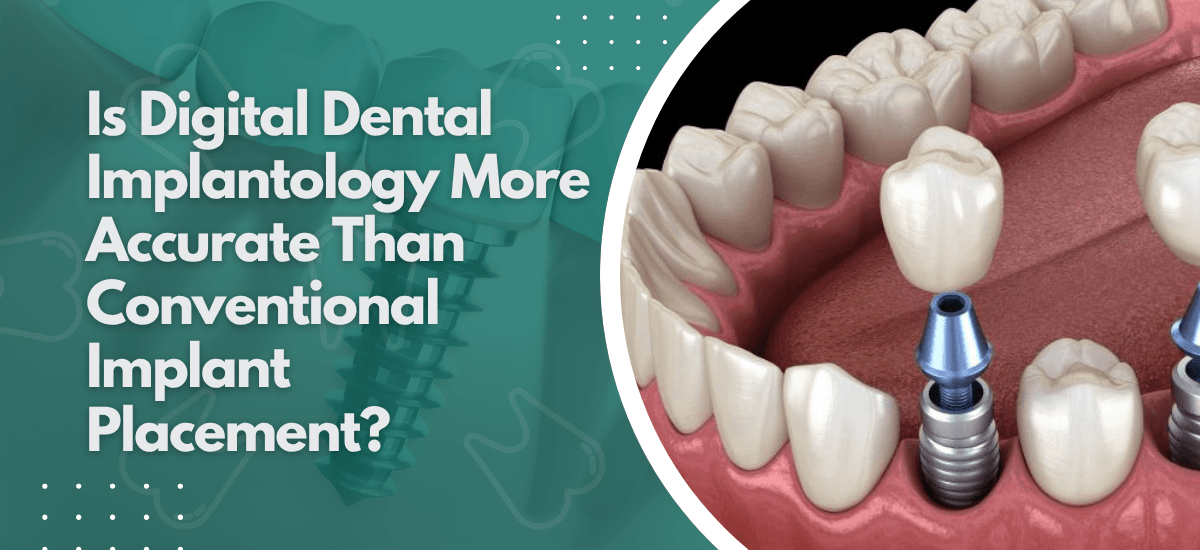
Digital dental implantology and conventional freehand placement both result in functioning implants, but the accuracy with which the implant reaches its planned position differs significantly between the two approaches. Systematic reviews across hundreds of clinical cases consistently show that guided digital placement reduces angular deviation by 50% or more compared to freehand surgery.
According to Dr. Suhrab Singh,a dentist at Neo dental clinic in Noida,
“Conventional placement depends entirely on the surgeon’s experience and spatial judgement. Digital planning removes that variable. When I can plan every implant on a 3D model before touching the patient, map the bone density, mark the nerves, and print a guide that physically locks the drill into position, the gap between planned and actual placement shrinks to a fraction of a millimetre. That precision changes outcomes, not just on paper but in how the final crown fits and how long the implant lasts.”
Interested in digital implant planning for your case?
What Makes Digital Implantology More Accurate Than the Conventional Approach?
The accuracy advantage of digital implantology comes from a structured workflow that eliminates the estimation required in freehand surgery at every stage.
- CBCT-based 3D planning: Every digital implant case begins with a cone beam CT scan that produces a three-dimensional map of the jaw, showing bone volume, density, nerve positions, and sinus proximity in precise detail.
- Surgical guide fabrication: The virtual plan is transferred to a 3D-printed surgical guide that fits over the teeth or gum tissue during surgery.
- Prosthetic-driven planning: In digital workflows, the crown position is planned first and the implant position is worked backwards from it.
- Dynamic navigation as an advanced option: Beyond static surgical guides, dynamic navigation systems provide real-time tracking of the drill position against the pre-planned virtual model during surgery, allowing adjustments mid-procedure.
Neo Dental Care was the first clinic in Noida to offer digital dental implantology, combining CBCT planning, surgical guide fabrication, and prosthetic-driven workflows for every guided implant case.
Where Does the Accuracy Difference Matter Most Clinically?
The gap between digital and conventional placement is measurable in all cases, but its clinical importance is greatest in specific situations.
- Aesthetic zone cases: Implants in the upper front teeth sit within direct line of sight and millimetres from adjacent roots, gum contour, and bone walls. A deviation of even 2 to 3 degrees in this zone can compromise crown aesthetics, gum tissue support, and the long-term stability of neighbouring teeth.
- Proximity to critical anatomy: The inferior alveolar nerve in the lower jaw and the sinus floor in the upper back jaw define hard limits on implant depth.
- Multiple implant cases and full-arch rehabilitation: When four or more implants need to be placed in parallel or at precise angles to support a bridge or full-arch prosthesis, small individual deviations compound into a prosthetic misfit that cannot be corrected without redoing the surgery.
- Reduced bone volume cases: When bone is thin, short, or grafted, the margin for positional error shrinks further.
Patients with jaw bone loss benefit most from digital guidance at the implant stage. If grafting was done beforehand, reviewing the grafting options for bone loss is a useful step before this consultation.
Factor | Digital Guided | Conventional Freehand |
Mean angular deviation | 2 to 4 degrees | 5 to 8 degrees |
Nerve and sinus safety | Mapped and guided | Dependent on surgeon judgement |
Prosthetic fit | Planned before surgery | Adjusted after placement |
Bone grafting compatibility | Optimised for limited bone | Relies on adequate native bone |
Suitable for aesthetic zone | High confidence | Variable, experience-dependent |
Why Choose Dr. Suhrab Singh at Neo Dental Care?
Dr. Suhrab Singh is an MDS-qualified implantologist at Neo Dental Care, Noida, the first clinic in Noida to introduce digital dental implantology, and a National Quality Achievement Award recipient for Best Dentist in Noida 2020. Every guided implant case at Neo Dental Care follows a fully digital workflow from CBCT scan through virtual planning, surgical guide fabrication, and prosthetic placement, all within the NABH-accredited Neo Hospital.
Frequently Asked Questions
Yes. Systematic reviews consistently show that computer-assisted guided placement reduces angular deviation by 50% or more compared to freehand surgery, with mean angular deviations of 2 to 4 degrees versus 5 to 8 degrees freehand.
The upfront planning cost is higher due to CBCT scanning, digital software, and surgical guide fabrication. However, the reduced risk of complications and revision procedures means the overall treatment cost is often comparable.
A surgical guide is a custom-fabricated template, usually 3D printed, that fits over the teeth or gum and physically directs the drill to the pre-planned implant position during surgery.
Most patients are suitable. A CBCT scan and digital planning assessment determine eligibility. Cases with severe bone deficiency may need grafting before guided surgery can proceed.