
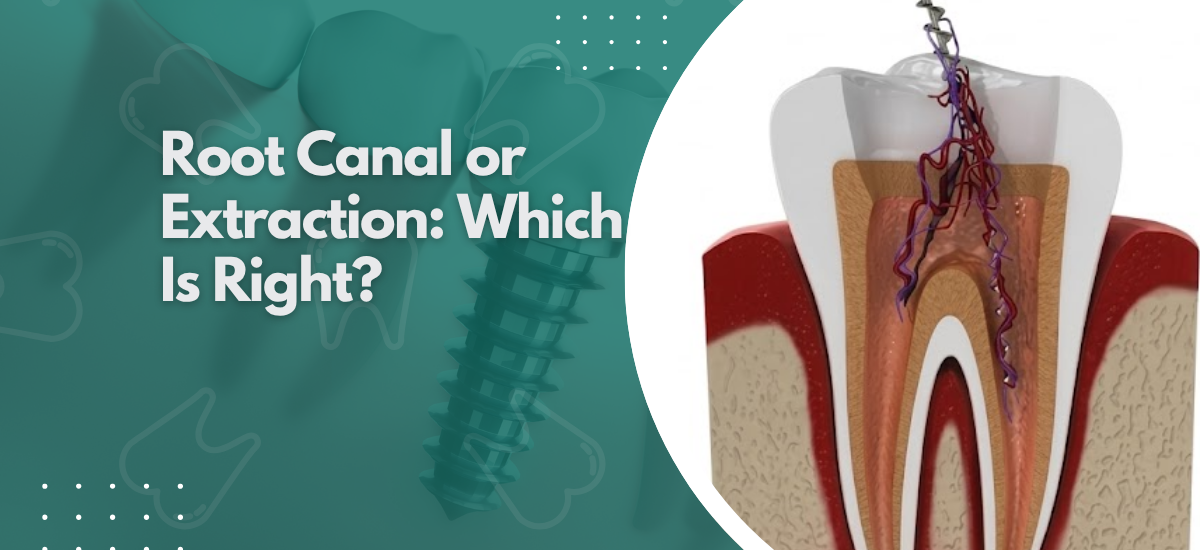
A root canal saves your natural tooth by removing the infected tissue inside and sealing it. An extraction removes the whole tooth. Choose a root canal to maintain jaw structure and prevent neighbouring teeth from shifting. Choose an extraction when the tooth is too damaged to save, has fractured below the gumline, or when the cost of saving it exceeds what makes sense clinically. In most cases where the tooth can still be restored, a root canal is the better long-term decision.
According to Dr. Suhrab Singh, a dentist at Neo Dental Care, one of the best dental clinics in Noida, “If there is tooth left to save, save it. Extraction looks cheaper on the day but the gap it leaves almost always costs more to sort out. An implant to replace a pulled tooth costs several times what a root canal and crown would have. And if the patient does nothing the neighbouring teeth start moving and the whole bite shifts over time.”
Unsure whether your tooth can be saved? Book an assessment with a dentist.
How Do Root Canal Treatment and Extraction Compare?
Both address a tooth that is infected or severely damaged. What they do differently and what they cost in the long run matters more than the upfront difference.
Factor | Root Canal Treatment | Tooth Extraction |
What it does | Removes infected pulp, seals and retains the tooth | Removes the entire tooth from the socket |
Natural tooth preserved | Yes | No |
Jawbone preserved | Yes — root stimulates bone | No — bone resorbs at extraction site |
Adjacent teeth affected | No | Yes — drift toward gap over time |
Treatment visits | 1 to 2, plus crown placement | 1, plus replacement procedure |
Surgery required | No | No for simple; yes for surgical extraction |
Upfront cost in Noida | Higher (root canal + crown) | Lower |
Long-term cost | Lower if tooth lasts decades | Higher when implant or bridge replacement is included |
Best suited for | Tooth with salvageable structure and adequate bone | Tooth fractured below gumline, vertical root fracture, severe bone loss |
A root canal alone does not complete the treatment a crown is placed afterward to protect the treated tooth from fracture. The full procedure and what it costs in Noida is covered on our root canal treatment in Noida page.
When Is Each Option the Clinically Right Choice?
When Is Each Option the Clinically Right Choice?
The right decision is not always obvious from pain alone. These are the specific situations that consistently determine which direction the recommendation goes.
- Root canal is the right choice when: The tooth has enough remaining structure above the gumline to support a crown after treatment. The infection is contained to the pulp and periapical area without severe surrounding bone loss. The patient is committed to placing a crown following the procedure as a root canal tooth left without a crown has a high fracture rate. Studies show that root canal treatment followed by crown placement produces 10-year survival rates comparable to implants for posterior teeth when performed in structurally sound teeth.
- Extraction is the right choice when: The tooth has a vertical root fracture that cannot be treated and will not respond to the root canal. Severe periodontitis has destroyed most of the bone supporting the root, leaving nothing to hold the tooth even after the infection is cleared. The tooth is so broken down that there is not enough structure remaining to support a crown, making root canal treatment futile even if the infection clears.
- The cost comparison over time: Extraction appears cheaper at the treatment stage. But a tooth left unreplaced starts a cascade of adjacent teeth drift, the opposing tooth over-erupts, and the bone at the extraction site begins shrinking within weeks. An implant placed months later into a ridge that has already resorbed often needs bone grafting first. A root canal and crown on the same tooth would have cost a fraction of that total. Studies confirm that extraction followed by implant replacement has a significantly higher total cost than root canal treatment over a 12-month horizon.
- When the decision is genuinely borderline: A tooth that has had a previous root canal, has developed a periapical lesion, and is now symptomatic again sits at a genuine crossroads. Retreatment is possible and often successful. So is extraction followed by an implant. The right answer depends on how much root structure remains, what caused the original failure, and whether the retreatment anatomy is accessible which is why CBCT imaging and microscopic assessment are both part of the evaluation at Neo Dental Care for any retreatment case.
The signs that a root canal has already failed and when retreatment is still an option versus when extraction becomes unavoidable are covered in detail in our blog on signs that a root canal has failed.
Why Choose Dr. Suhrab Singh at Neo Dental Care?
Dr. Suhrab Singh is an MDS-qualified endodontist at Neo Dental Care, Noida, National Quality Achievement Award recipient for Best Dentist in Noida 2020, based inside the NABH-accredited Neo Hospital. With over 15,000 root canal procedures performed under dental operating microscopes, Dr. Suhrab Singh assesses every case for retreatability before recommending extraction including CBCT imaging and pulp vitality testing to confirm the diagnosis. Patients who arrive having already been told to extract are given a full second assessment before that recommendation is confirmed.
Frequently Asked Questions
In most cases, yes if there is enough tooth left to restore. You keep the natural tooth, the jawbone stays intact, and nothing shifts. Extraction costs less today but the gap it leaves usually ends up costing more to sort out later.
When the tooth cannot be saved. A vertical root fracture, bone loss that has gone too far, or not enough tooth structure left to hold a crown any of these make root canal pointless. The tooth has to be extractable in those cases.
Less than people expect. The infection is what hurts once that is numbed, the procedure itself is manageable. Some soreness for a couple of days afterward is normal and settles on its own.
The bone at that site starts shrinking within weeks. Neighbouring teeth drift into the gap. The tooth above or below starts moving down or up to fill the space. Left long enough, what started as one missing tooth becomes a bite problem across the whole arch.
Reference:
- https://pmc.ncbi.nlm.nih.gov/articles/PMC10441609/
- https://pmc.ncbi.nlm.nih.gov/articles/PMC12788601/
Desclaimer:
This blog is for informational purposes only and does not constitute professional dental advice. Please consult a qualified dental professional for a diagnosis and personalised treatment plan.