
Dental Implant Cost in Noida
Cost depends mainly on the implant system, the crown type, your bone condition, and whether any additional procedures are needed. Here’s the breakdown:
Implant Type | Cost | What’s Included |
Single Tooth Implant — Economy System | ₹40,000 | Implant fixture + DMLS crown |
Single Tooth Implant — Premium System | ₹45,000 | Implant fixture + zirconia crown |
Full Arch — All-on-4 / All-on-6 | ₹3,50,000 – ₹6,00,000 | Implants + digital guide + fixed prosthetic |
CBCT 3D Scan | ₹2,000 – ₹6,000 | Diagnostic imaging before treatment |
Bone Grafting / Sinus Lift | ₹8,000 – ₹30,000 | Only when bone volume is insufficient |
Shown prices for estimate purposes only. Prices may vary depending on the complexity of the case and the patient’s clinical requirements.
A few things move the number within these ranges: the implant brand, whether the quote already includes the crown and abutment, the crown material (zirconia costs more than metal-ceramic), and whether CBCT scanning and a digital guide are actually part of the plan. For a wider comparison across treatment types, see dental implant cost in Noida. For full-mouth cases specifically, see full mouth rehabilitation with All-on-4.
Digital Implant Procedure: Step by Step

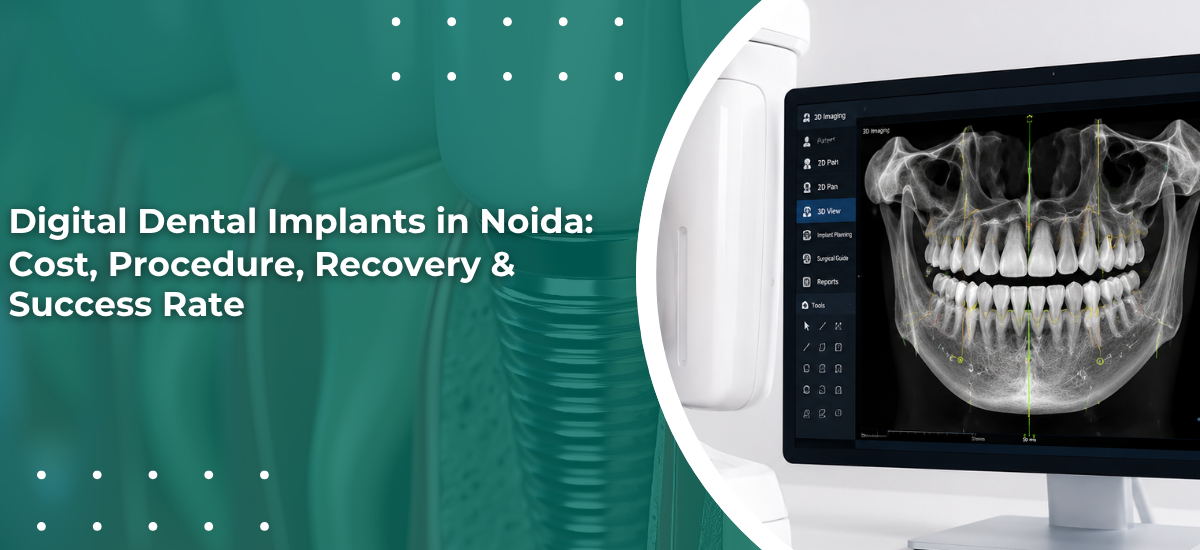
- 3D Diagnostics.CBCT imagingand an intraoral digital scan map bone density, nerve position, and sinus location in 3D before any planning starts. More on CBCT scan matters before implants.
- Virtual Treatment Planning.Implant position, angle, and depth get planned on-screen, working carefully around the sinus and major nerves.
- Computer-Guided Placement.A custom surgical guide directs the titanium implant into the exact planned position, with sub-millimeter accuracy and a smaller incision than freehand methods need.
- Osseointegration.The implant fuses with the jawbone over 3 to 6 months — the phase that matters most for how the implant holds up long-term.
- Prosthetic Loading.A custom CAD/CAM-designed crown, usually zirconia or ceramic, gets fitted onto the abutment, bringing back both function and appearance. In select cases with strong bone support, a same-day temporary crown is possible too.
Recovery Timeline After Digital Implant Surgery
Recovery is usually smoother here than with traditional implants, simply because the procedure itself is less invasive. It still happens in stages, though.
- Days 1–3:Mild swelling or soreness, managed with medication and a soft diet.
- Days 7–14:Initial soft tissue healing around the surgical site; stitches come out if they were used.
- Weeks 2–4:Gum tissue settles down, and most patients feel close to normal again.
- 12–24 Weeks (3–6 Months):Full osseointegration the implant becomes structurally fused with the jawbone.
- Final Visit:The permanent crown goes on once healing is confirmed.
Stick to soft foods in the first few days, actually follow the post-op instructions rather than skimming them, and don’t skip the follow-ups. Oral hygiene through this window makes a bigger difference to healing than most patients expect.
Success Rate of Digital Dental Implants

Digital dental implants run a 95–98% success rate in healthy patients with good oral hygiene noticeably higher than the roughly 90%+ usually quoted for conventional freehand implants, mainly because CBCT-guided planning cuts down surgical risk and placement error.
What still affects an individual case: bone quality and quantity, how well you keep up with oral hygiene, whether you smoke, diabetes or other systemic conditions, and how experienced the dentist is with guided implant systems specifically. A CBCT-based evaluation before treatment is what actually determines candidacy a visual exam on its own isn’t enough to go on.
If bone loss is part of your situation, see implant with jaw bone loss and sinus lift surgery. For how long implants typically last once placed, see long a dental implant lasts.
Why Choose Neo Dental Care in Noida?
Neo Dental Care builds its digital implant treatment around CBCT imaging, CAD/CAM planning, and computer-guided surgery, led by Dr. Suhrab Singh, whose background covers both endodontics and implantology.
Patients tend to pick this route for the same handful of reasons: planning that’s genuinely more precise, a diagnostic visit that’s more comfortable than they expect, surgical outcomes that are more predictable, cost conversations that happen upfront instead of after the fact, and same-day crown eligibility for cases that qualify.
Book a Consultation
Frequently Asked Questions
Digital dental implants have a 95% to 98% success rate in healthy patients with good oral hygiene. CBCT-guided planning improves accuracy and lowers surgical risk compared to freehand placement.
Sometimes, though it depends on how much bone and healthy tooth structure remain.
Yes, digital implants typically cost 10% to 20% more than conventional implants because of the CBCT imaging and computer-guided planning involved. That extra cost usually pays for itself through a lower complication rate and better long-term value.
Yes, provided the condition is well managed. A dental evaluation, and medical clearance if needed, happens before treatment begins this isn’t something left to guesswork.
No. It’s only needed when there isn’t enough natural bone to support the implant, and a CBCT scan is what determines that during treatment planning.
In select cases, yes it comes down to strong initial implant stability and adequate bone support, which the dentist confirms during surgery itself.