
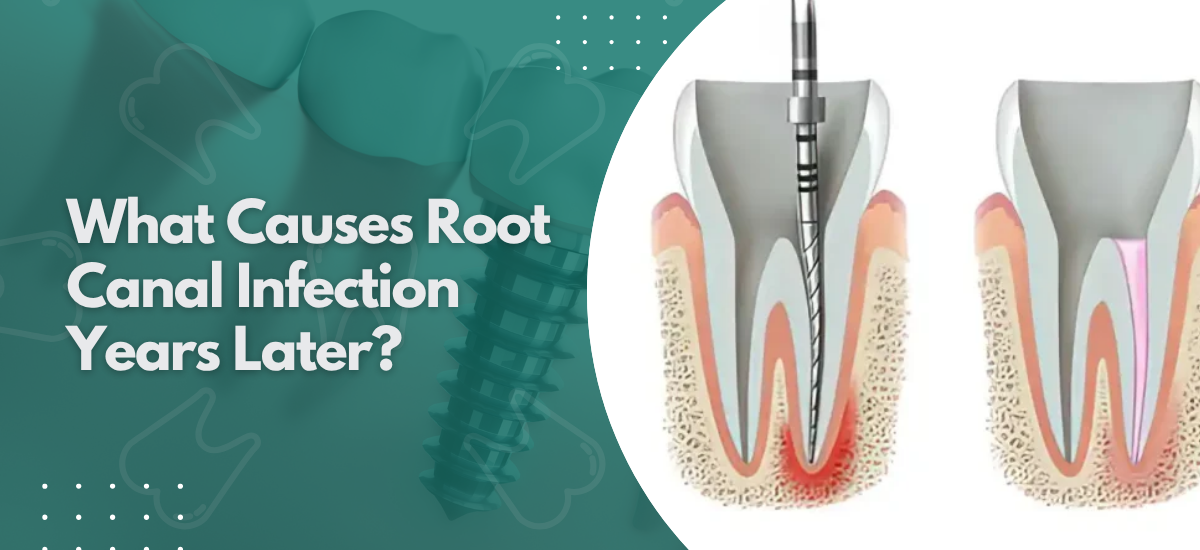
Root canal infections occur years later because bacteria find their way back in. A failing crown or filling, a new cavity that reaches the root filling, microscopic cracks in the tooth, or bacteria left behind in hard-to-clean accessory canals that the original procedure could not fully reach. Once inside they multiply quietly. A periapical lesion builds at the root tip. Symptoms appear late, sometimes months or years into the process.
According to Dr. Suhrab Singh, one of the best dentists in Noida, “The canals are sealed, not sterilised. A successful root canal ten years ago is not a guarantee the tooth is immune to failure. If the crown starts leaking, bacteria reach the root filling within weeks. If a canal was missed because the anatomy was complex, those bacteria have been active since day one. A standard X-ray often misses both. That is why CBCT and a microscope are not optional in retreatment.”
What Are the Main Causes of Root Canal Infection Years Later?
The causes are specific and each one creates a different pathway for bacteria to re-enter a sealed tooth.
- Coronal leakage from a failing restoration: The crown or filling over a root canal treated tooth is the only thing standing between the sealed canals and bacteria in the mouth. Gaps at the margins, cracks, or decay around the edges break that seal. Once it is breached, bacterial penetration into the root filling happens within weeks to months. The root canal has not failed from the bottom bacteria coming in from the top.
- New decay reaching the root filling: A root canal treated tooth can still get cavities. If decay goes undetected and progresses far enough, it breaks through the crown structure and exposes the root filling material to bacteria. Entirely preventable with regular dental review.
- Missed canals from the original treatment: Molars often have more canals than a 2D X-ray can show. A systematic review found that teeth with untreated missed canals were more likely to develop periapical pathology. When a canal goes untreated, the bacteria in it have been active since the original procedure.
- Cracks in the tooth structure: Hairline cracks in the root or crown create bacterial pathways that neither a crown nor a filling can seal. These are rarely visible on standard X-rays and need CBCT or microscopic examination to identify. Teeth left without crown coverage after root canal are significantly more prone to developing these cracks from unprotected bite load.
How root canal treatment is performed at Neo Dental Care, including the role of CBCT planning and dental operating microscopes in identifying missed canals and complex anatomy, is covered on our root canal treatment in Noida page.
How Is Root Canal Reinfection Diagnosed and Treated?
The infection is often present long before symptoms appear. Diagnosis and treatment depend on what is driving the reinfection.
- Signs to look for: A previously pain-free root canal treated tooth that starts producing pain on biting, spontaneous throbbing, gum swelling near the root, a visible bump or pimple on the gum, or a persistent foul taste. On X-ray, a dark shadow at the root tip confirms periapical bone loss from infection. Pain is not always the first sign some lesions are found on routine X-rays before any symptoms appear.
- Diagnosis with CBCT imaging: A 2D periapical X-ray gives a rough picture. It does not show the three-dimensional canal anatomy, accessory canals, or root cracks. A CBCT scan provides all of this in a single scan, identifying missed canals, the extent of bone loss, and whether enough tooth structure remains for retreatment. Every retreatment case at Neo Dental Care starts with CBCT before any instrumentation.
- Root canal retreatment: Old filling material comes out under dental operating microscope. Canals are re-cleaned, re-disinfected, and previously missed canals are located and treated. The tooth is then resealed. Microscopic guidance identifies residual infection and anatomical detail that a naked eye or standard X-ray cannot. Success rates under microscope are significantly higher than conventional retreatment.
- Apicoectomy for persistent infection at the root tip: When infection is confined to the root apex and retreatment through the crown is not viable, a surgical apicoectomy removes the infected tip. The root end is cut back, cleaned, and sealed from below. The periapical lesion resolves without disturbing the coronal restoration.
How to recognise when a root canal has failed and what the clinical signs look like before an infection becomes severe is covered in detail in our blog on signs that a root canal has failed.
Why Choose Dr. Suhrab Singh at Neo Dental Care?
Dr. Suhrab Singh is an MDS-qualified endodontist at Neo Dental Care, Noida NABH-accredited, inside Neo Hospital, Sector 50, recipient of National Quality Achievement Award 2020, with over 15,000 root canal procedures performed under dental operating microscopes. All retreatment cases at Neo Dental Care start with a CBCT scan to identify missed canals, cracks, and periapical bone loss before any instrumentation begins. Root canal retreatment and apicoectomy are both available in-house under microscopic guidance.
Frequntly Asked Questions
Yes and it happens more often than patients expect. A leaking crown, new decay, a crack, or bacteria in an untreated accessory canal can all reinfect a sealed tooth. The process is quiet at first and symptoms often appear long after the infection has already established itself.
Pain on biting or throbbing in a tooth that was previously fine, gum swelling near the root, a pimple-like bump on the gum, or a persistent foul taste. A dark shadow at the root tip on an X-ray confirms periapical infection even when no pain is present yet.
Most cases can be retreated, especially under microscopic magnification. If the infection is only at the root tip, an apicoectomy removes it surgically without touching the crown. Extraction only becomes the answer when the tooth is fractured in a way that cannot support any further restoration.
Most well-restored root canals last 10 to 15 years or more. Failure can happen at any stage and is most commonly driven by a leaking or failing crown, missed canals in complex anatomy, or bacterial species that survived the original disinfection.
Disclaimer
This blog is for informational purposes only. Please consult a qualified dentist before making any treatment decisions.